Friday, May 15, 2020

COVID_19 CALIFORNIA : A MESSAGE FROM ANNIE

I have been impacted by COVID-19 is several ways. As a university instructor, abruptly, I lost all face to face contact with students to embark on a new journey with weekly online Zoom class meetings.
Zoom class meetings
It has been tricky to hold space and still deliver academic content for the students' who have faced so many challenges. I have tried to find the fulcrum as I have endeavored to balance listening, caring, providing resources, all while trying to humanize online instruction.


The space between my lap top screen and their device feels so far away.  I have had students who have lost housing, living in their car yet, show up for our online class from their vehicle in a parking lot so they could access free wifi. I have had students who have lost jobs, unable to buy food, or lacked appropriate devices to be able to complete their school work, or didn't have internet and sat on the porch of a neighbor's house who graciously allowed them to access their wifi so they could attend online classes.
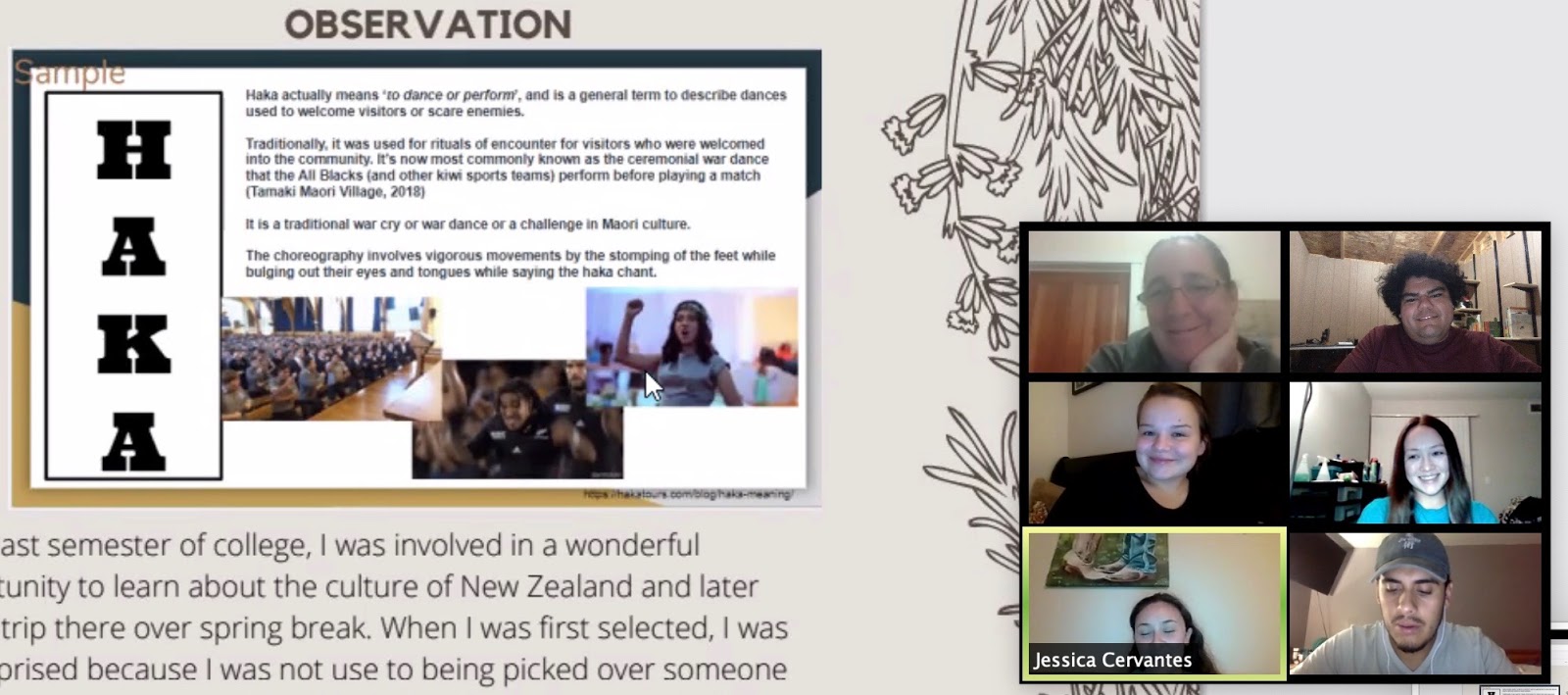
Sharing a little of Aotearoa New Zealand in their zoom meeting
Every time a student doesn't show up for the weekly online class, a sense of fear overwhelms me. For each response reveals burdens, struggles, sickness and sometimes death. When these students do not show up for the scheduled weekly online Zoom class, I reach out with persistence (maybe a little like stalking) through email and text to see if they need support. I found out one student didn't show up to our online class because they had been in the ICU for 5 days on a ventilator. And yet, the following week, their face was shining bright across the screen. The student's father walked into her bedroom during our Zoom class, and in front of all the other students, with tears in his eyes, thanked me for calling and checking up on his daughter, as it showed how much I cared as a professor.  I have had several students lose grandparents and relatives to COVID -19. And so many more afraid for the health and well being of their families and friends
Graduation Day at University
Yet, with all the uncertainties we face for the future of higher education, I have found a deep sense of gratitude for my university, colleagues, students and community. I have seen my university provide resources for students who are in financial need. For example, I was able to refer the student who was living in their car to the university CARES team who was able to provide funds for the student to get stable housing. Others have accessed funds to purchase food, pay utilities, etc.  Also, I have seen students give back by serving their community online through answering emergency hotline phones, reading books to children, translating text into multiple languages, calling elderly who are alone, and so many more ways. It has made me proud to be a part of something greater than myself.
Annie White, Brenda Soutar and Wendy Lee at the California State University Channel Islands
As we are nearing the end of this semester with financial loss and the fall semester instruction delivery method unknown because of COVID -19, I have been provided the gift of time, to slow down, and listen more deeply to others, lean into the uncomfortable silence, embrace the shadow and light that surround me. Though the Zoom online classes will come to an end, perhaps in the fall, or possibly later, as the screens go dark, the students will never fade. Their stories will linger, as we all hope to move forward in the future, to a time where we can look back at the past without staring.

Much love to you all
Annie

Annie White, Ed.D.
Assistant Professor of Early Childhood Studies, School of Education
California State University Channel Islands

Monday, December 9, 2019

Culture, language and identity: children’s stories woven with teachers’ stories in a bi/multicultural curriculum

An article by Mihaela Enache

November 2019
______________________________________________


Titiro whakamuri kia anga whakamua.Look to the past in order to move forward. 
(Maori whakatauki).

To be yourself in a world that is constantly trying to make you something else is the greatest accomplishment
(Ralph Waldo Emerson).

Our identity is like a stake in the sand
(Melinda Webber, 2014, private conversation).  

In an increasingly globalised world, it becomes imperative for teachers to honour children's individualities, their identities and cultures. One approach to this complex task is through the power of storying, of listening to, telling and writing stories..... 


Mihaela Enache has just published a new article we would love to share with you, as a result of her presentation at Educational Leadership Ltd's Celebrating Learning Stories Conference in October 2018.  This article was inspired by Mihaela's PhD proposal on (immigrant) teacher identity. 

Mihaela Enache is a PhD candidate at the University of Auckland. To read the article please visit our website: https://www.elp.co.nz/articles.cfm.

Wednesday, June 26, 2019


Check out the website for more details and to see who the finalists for 2019 are!

Monday, March 25, 2019

Aotearoa New Zealand continues to mourn the lives of those taken on March 15. There has been an enormous response from the whole Aotearoa New Zealand community of love and solidarity in communities large and small. It gives us great heart to know that research indicates that this collective experience/trauma of emotions will lead to long term solidarity. The Muslim community have acted with such grace under the most extraordinary circumstances. When Al Noor Mosque Iman Gamal Fouda, who survived Friday’s attacks spoke, telling the people of Christchurch that NZ was unbreakable… "We are broken-hearted, but we are not broken. We are alive, we are together, we are determined to not let anyone divide us." The very foundation of Islam is the notion of peace, we as a nation have certainly witnessed this. Faced with incredible suffering Muslims throughout Aotearoa New Zealand have responded with warmth and generosity. 

Acknowledging the leadership of Prime Minister Jacinda Ardern. Her empathy, compassion and love has been an inspiration not only to everyone in Aotearoa New Zealand, but globally. There has been global praise from Leaders throughout the world, thanking her for the way in which she has handled the aftermath of this massacre.
As His Highness Shaikh Mohammad Bin Rashid Al Maktoum who is the Vice President and Prime Minister of the UAE as well as the Ruler of Dubai,"Thank you PM @jacindaardern and New Zealand for your sincere empathy and support that has won the respect of 1.5 billion Muslims after the terrorist attack that shook the Muslim community around the world."

This little movie attached to this post is backed by Dave Dobbyn’s song written specifically for new immigrants landing on our shores, it is a celebration of our nations desire to both welcome and celebrate our diversity. What follows below are the lyrics to this song as well as the translation into Maori by Te Haumihiata
Arohanui, Wendy on behalf of ELP


Welcome Home
Dave Dobbyn

Tonight I am feeling for you
Under the state of a strange land
You have sacrificed much to be here
There but for grace as I offer my hand


Welcome home, I bid you welcome, I bid you welcome
Welcome home from the bottom of my heart


Out here on the edge

The empire is fading by the day
And the world is so weary in war
Maybe we'll find that new way

So welcome home, see I made a space for you now


Welcome home from the bottom of our heart
Welcome home from the bottom of our hearts


Keep it coming now keep it coming now

You'll find most of us here with our hearts wide open
Keep it coming now keep on coming now 
Keep it coming now keep on coming now


There's a woman with her hands trembling

And she sings with a mountain's memory 

There's a cloud the full length of these isles

Just playing chase with the sun
And it's black and it's white and it's wild
All the colours are one

So welcome home, I bid you welcome, I bid you welcome


Welcome home from the bottom of our hearts

Welcome home, see I made a space for you now
Welcome home from the bottom of our hearts
From the bottom of our hearts


Welcome Home lyrics © Universal Music Publishing Group, Words & Music A Div Of Big Deal Music LLC


Nau Mai Rai
nā Te Haumihiata Mason

kei te aroha au ki a koe
e tānoatia nei e tauwhenua
rawa kore mai koe ki konei
ka toro te ringa ki tō kaha

nau mai rā, ki te papa, papa tipu
nau mai rā, te karanga a te ngākau

tū ana i te pari
horo kau iho te ao
kua ruha i te pakanga
rapua he ara hou

nau mai rā, tēnei rā tō kāinga
nau mai rā, te karanga a te ngākau

haere tonu mai, haere tonu mai
ko te ngākau tuwhera ka tū atu nei

haere tonu mai, haere tonu mai
haere tonu mai, nau mai haere mai

kua pōhiri te reo karanga, haere mai
kua pōhiri ngā maunga, haere mai

ko te ao tea roa o konei
te hoa tauwhai o te rā

mā te pango, te mā, me te pai
ka iwi kotahi te ao

nau mai rā, ki te papa, papa tipu
nau mai rā, tēnei rā tō kāinga
nau mai rā, te karanga a te ngākau
te karanga a te ngākau


Monday, March 18, 2019

Christchurch Terror Attack

I have felt so paralysed by the events of Friday 15thin Christchurch and am still lost and unable to find an adequate response. It is just too difficult to comprehend and I never imagined such violent-fueled bigotry would invade our peaceful country.

It has been a weekend of: Horror
Hurt
Trauma
Pain
Shock
Sorrow
Devastation
Grief
Tears 
Loss of innocence

I felt my body closing down inside the intensity of all that was happening. Tears flowed without warning for families and friends of our Muslim community and our country. All our lives have changed forever. 
The people murdered and hurt were by-and-large migrants and refugees who had chosen NZ as their home, a safe haven away from the horrors of wars and torture that afflict far-away places. It is heart-breaking, because we are a peace loving country and as Jacinda Adern said: This is not us!
How could such hatred be in our midst and no one be aware? How did this happen? For Christchurch, a city still in recovery from the 2011 earthquake, this new assault is not due to nature but to a heinous hate crime. It will take a very long time to recover from this. 
It has certainly been a wakeup call for everyone in Aotearoa, NZ as to just how important it is, in a civilised society, to call out any form of racism. And we must also question the right of anyone to publicly state their bigoted views. Words do matter, especially in today’s media-dominated world. Just as we do not allow physical harm, neither should we allow verbal harm. 

The messages we send in our day-to-day conversations, as well as those we listen to, must at all times be checked to ensure they protectour world and all those who live in it. People have been talking about the pernicious effect of the internet in supporting these horrific events and what part these huge internet platforms are playing in encouraging this form of extremism. 


Gun control is again an issue here, and our Prime Minister Jacinda Ardern has said simply “I can tell you right now, our gun laws will change”. 
We must not forget that at the heart of this is a group of people who will be haunted by this experience for a very long time. Last night, in my hometown of Hamilton we joined thousands of people who came out in support of the Muslim community to show solidarity at an evening vigil. Amongthe many Muslim spokespeople was our local leader Waikato Muslim Association's Dr Asad Moshin who graciously thanked people for the support: "We still don't know how this happened, but we won't let this change New Zealand. A lot of good has come out of this. People didn't know where the mosque was, where the Muslim community was. But we will keep this going. We are so overwhelmed, as a Muslim community, with the support. We are thinking how can we pay back this outpouring of support. Keep us in your prayers.” 
New Zealanders have been meeting all over the nation in their thousands to stand with Muslims in their grief and to show solidarity. They have been gathering outside mosques and in community spaces. Flowers and significant messages have been written in cards, fundraising has skyrocketed, people are talking to each other. As our Prime Minister Jacinda Ardern said the incident was “one of New Zealand’s darkest days” and that the victims had chosen to make New Zealand their home. “They are us,” she said. There is a very strong message to all in her words. ‘We are one people”. 
She also said that the person who perpetuated this violence against us is not us. Why not? We must ask ourselves: what happened to this person to generate such bigotry and hate? He stated that as a boy he was not interested in school education, that education had nothing in it for him. Was this the seed that, for him, set him down a path of pure evil? Can we see here the vital importance of engaging children in strength based education from an early age?

I thought it was ironic that we had just posted, last week, on YouTube (third in the series on Learning Stories) a video entitled 'PART 3: A child’s culture cannot enter a classroom before it first enters a teacher’s conscience’. Each of us in our own way through our daily lives can make a difference. Every day as we interact with people, those we agree with and those we do not, we can make sure that hateful racist comments are always challenged and never tolerated. Teachers can write Learning Stories that will make visible what we value in our communities. They are such powerful opportunities to demonstrate our care, compassion and empathy. A Learning Story is alsoa formidable platform to promote the best in everyone. 


Nga mihi nui,
Arohanui,

Wendy

Thank you to Stuff.co.nz for the use of photographs in this blog,  please find all photos at this site. 

In pictures: Christchurch shooting | Stuff.co.nz

https://www.stuff.co.nz/national/111343030/in-pictures-christchurch-shooting


Friday, September 21, 2018

Words from Germany


This is a post sent from Germany where five members of the ELP team are working with teachers in 9 German cities and one city in Switzerland. This is a press release from the University of Koblenz, which has been translated via Google translates into English. We are experiencing a tremendous amount of interest in Learning Stories. Many of the teachers have been on this journey with us over several years. We are meeting new teachers and also connecting with many we have worked with in earlier times.


Neuseeländische Erziehungswissenschaftlerin Wendy Lee begeisterte mit ihrem Vortrag über Lerngeschichten


Mit einem enthusiastischen und inspirierenden Vortrag über die „Philosophie der Learning Stories“ zog Wendy Lee, Direktorin des neuseeländischen „Educational Leadership Project“, die Zuhörerinnen und Zuhörer an der Hochschule Koblenz in ihren Bann. Rund 300 Personen waren der Einladung des Fachbereichs Sozialwissenschaften und des Instituts für Bildung, Erziehung und Betreuung in der Kindheit|Rheinlad-Pfalz (IBEB) gefolgt, um an diesem Abend von Neuseeland lernen zu können.

Der Präsident der Hochschule, Prof. Dr. Kristian Bosselmann-Cyran, begrüßte die international renommierte Referentin, die gemeinsam mit vier weiteren Mitarbeiterinnen des „Educational Leadership Project“ angereist war, um am Folgetag gemeinsam mit Studierenden der Hochschule in fünf Workshops arbeiten zu können. „Lerngeschichten sind ein ganz zentrales Element der Qualitätsentwicklung und Evaluation“, betonte Prof. Dr. Armin Schneider, Direktor des IBEB und Prodekan des Fachbereichs Sozialwissenschaften, in seinem Grußwort, „es ist wichtig, dass wir wesentliche Merkmale der Lerngeschichten wie Haltung, Diskurs, Familien- und Sozialraumorientierung in eigenen Ansätzen der Qualitätsentwicklung aufgreifen und weiter denken.“

Wie bedeutsam eine respektvolle, ressourcenorientierte und auf Austausch fokussierte Haltung für den Erfolg von Lerngeschichten ist, stellte Wendy Lee in ihrem Vortrag eindrücklich dar. Zahlreiche Foto- und Videoaufnahmen zeigten anschaulich, wie sehr Kinder und ihre Familien davon profitieren, wenn häufig und vor allem auf wertschätzende Art und Weise Geschichten über besondere Momente und wichtige Lernerlebnisse von Kindern aufgeschrieben werden. Für Kinder und Eltern ist es ein besonderer Gewinn, diese Geschichten immer wieder anschauen und lesen zu können. Durch die Dokumentation von Lerngeschichten erfahren Kinder und Eltern eine hohe Wertschätzung und sie können gemeinsam mit den Fachkräften über das Lernen von Kindern sprechen. Dass es hierfür hilfreich sein kann, die Familien der Kinder auch zuhause zu besuchen, wurde von Wendy Lee besonders betont. Notwendig sei es, die kulturelle Vielfalt von Familien zu berücksichtigen und die Teilhabe von Familien zu gewährleisten. Hierfür braucht es in den Augen der neuseeländischen Referentin nicht nur die Öffnung der Kindertageseinrichtungen, sondern durchaus auch neue Wege der Kommunikation mit Familien. Manchmal könne es hilfreich sein, bedeutsame Lernerlebnisse der Kinder telefonisch oder sogar per Email zu übermitteln. „Das Schreiben von Lerngeschichten ist eine besondere Verantwortung, um Kinder und deren Familien mit offenem Herzen und Verstand zu begleiten, um neugierig und engagiert als Gemeinschaft von Lernenden zu wachsen und schließlich auch, um die eigene Professionalität beständig weiter entwickeln zu können“, so Wendy Lee.


Dass es in deutschen Kindertageseinrichtungen jedoch gar nicht so leicht ist, regelmäßig Lerngeschichten von Kindern zu dokumentieren, die auch die Lernschritte eines Kindes transparent machen, zeigte die rege Diskussion am Ende des Vortrags. Pädagogische Fachkräfte kämpfen hierzulande mit unzureichenden strukturellen Rahmenbedingungen, die es fast unmöglich machen, mehr als eine Lerngeschichte im Jahr zu verfassen. „Hier muss einfach investiert werden“, so Prof. Dr. Schneider. Dem stimmte Prof. Dr. Regina Remsperger-Kehm zu, die selbst Mitarbeiterin im Projekt „Bildungs- und Lerngeschichten“ des Deutschen Jugendinstituts war und die als Professorin des Fachbereichs Sozialwissenschaften die Vortragsveranstaltung geplant und konzipiert hat: „Wenn wir es ermöglichen wollen, dass Kinder ihren Interessen vertieft nachgehen können und wenn wir für Kinder eine Lernumgebung schaffen wollen, in der sich Kinder wohlfühlen und sich voll Vertrauen auf das einlassen können, was sie interessiert, dann müssen wir auch für pädagogische Fachkräfte Rahmenbedingungen schaffen, in denen sie die Lernprozesse von Kindern achtsam begleiten können“. Im Gespräch zu bleiben und den Dialog mit Fachkräften, Eltern, Kindern und Verantwortlichen aus Politik und Wissenschaft fortführen, um von Neuseeland lernen zu können, lautet der deutliche Appell der Wissenschaftlerin.


New Zealand educationalist Wendy Lee enthused with her talk about learning stories

09/18/2018


RheinMoselCampus Koblenz TOP University of Social Sciences

Wendy Lee, director of the New Zealand Educational Leadership Project, cast a spell over the audience at Koblenz University of Applied Sciences with an enthusiastic and inspiring presentation on the "Philosophy of Learning Stories". Around 300 people accepted the invitation from the Department of Social Sciences and the Institute for Education, Childhood Care and Support | Rheinlad-Pfalz (IBEB) to learn about New Zealand that evening.

The President of the University, Prof. dr. Kristian Bosselmann-Cyran, welcomed the internationally renowned speaker, who had traveled with four other employees of the "Educational Leadership Project", in order to work together with students of the university in five workshops the following day. "Learning stories are a very central element of quality development and evaluation," emphasized Prof. Dr. med. Armin Schneider, Director of the IBEB and Vice Dean of the Department of Social Sciences, in his welcome address, "it is important that we take up and continue to think essential characteristics of the learning stories such as attitude, discourse, family and social space orientation in our own approaches to quality development."

How significant a respectful, resource-oriented and exchange-focused attitude is for the success of learning stories was impressively demonstrated by Wendy Lee in her presentation. Numerous photo and video recordings clearly showed how much children and their families benefit from it, if and often Appreciative way stories are written down about special moments and important child learning experiences. For children and parents it is a special benefit to be able to watch and read these stories over and over again. By documenting learning stories, children and parents are highly valued and they can talk to the professionals about learning to be a child. That it can be helpful to visit the families of the children at home was emphasized by Wendy Lee. It is necessary to consider the cultural diversity of families and to ensure the participation of families. In the eyes of the New Zealand representative, this not only requires the opening up of day-care centers, but also new ways of communicating with families. Sometimes it can be helpful to convey meaningful children's learning experiences by phone or even email. "Writing learning stories is a special responsibility to accompany children and their families with open hearts and minds, to grow inquisitively and committedly as a community of learners, and ultimately to continue to develop their own professionalism," said Wendy Lee.


However, the fact that it is not so easy in German daycare facilities to regularly document learning stories of children, which also make the learning steps of a child transparent, was shown by the lively discussion at the end of the lecture. Educational specialists are struggling in this country with insufficient structural conditions that make it almost impossible to write more than one learning story a year. "It simply has to be invested here", says Prof. Dr. med. Cutter. Prof. Dr. Regina Remsperger-Kehm, who was herself a member of the project "Bildungs- und Lerngeschichten" of the German Youth Institute and who, as a professor of the Department of Social Sciences, planned and planned the lecture: "If we want to enable children to pursue their interests in depth and if we want to create a learning environment for children in which children can feel at home and confidently embrace what they are interested in, then we also have to create framework conditions for educational professionals in which they can mindfully accompany children's learning processes ". To stay in the conversation and continue the dialogue with professionals, parents, children and political and scientific leaders to learn from New Zealand, is the clear appeal of the scientist.


Tuesday, September 11, 2018

The role of intuition in learning and teaching


Guy Claxton has always been one of my go to learning hero’s, and teachers who know me well will tell you that “the ability to hang out in the fog, and to tolerate confusion” is one of my favourite quotes.  Recently I have been reflecting on something I read, implying that intuition will only take a leader so far, that it is knowledge and skills that will determine success.  One of the successful attributes of a great leader in my eyes, is their ability to develop, and nurture community.  In such a community everybody is valued as leaderful and are aware of the strengths that they contribute to make a community thrive.  While knowledge and skills are important, Claxton believes that “you either..enable people to harness and develop their intuition, or..neglect it, and so allow it to waste away” (p. 50), What does achieving this balance mean in practice?

Claxton, in his book “The intuitive practitioner” discusses the intuitive “ways of knowing” as expertise, implicit learning, judgement, sensitivity, creativity/problem solving and rumination. (pg. 40).
Let’s look at these “ways of knowing” and what they mean for leaders:
Expertise– the ability to truly be present and responsive to people in the moment, with your mind open to the possibilities; without having to think about ticking off boxes.  Weaving local curriculum, unpacking key documents to make sense of them through the lens of your unique community, your interpretation based on your ways of being. Expertise is about people not accountability to knowledge and skills.
Implicit Learning– always being open to learning, alongside the children, the teachers, your immediate and wider community in ways that you would never image;
Judgement – during the ELP lecture series titled Who said Good is Good  my reflective colleague Lynn Rupe discussed who says good is good? What is right in this moment, for this child, for this family?  Do you make decisions as a collective to ensure synergy?
Sensitivity– listening with your heart, your tummy and your head; what does this look like, feel like, sound like?  Deeply reflective relationships, where everyone is seen as an individual, and responded to as such;
Creativity– developing a ‘yes’ culture, how can we do this?  Let’s push the boundaries of our practice, be innovative and divergent. It is ok to make mistakes, as it is through our mistakes that we learn.  Sometimes the best ideas come in those times of quiet, when we are least expecting them.
Rumination– Claxton refers to “the process of ‘chewing the cud’ of experience in order to extract its meanings and implications”.  I wonder if this could be the new catch phrase for Internal Evaluation?

Claxton’s description of a teacher going about their day “adjusting or even abandoning their actions and intentions as they go, without being conscious of much reasoning, and without being able to say why or how they made the decisions they did, or to what clues they were responding” (pg. 35), resonates with me, and I am reminded of this video clip that was recently shared with me.  

In this now moment where are you?

Is your logical rational brain (left brain) dominant?  When faced with a making a decision do you write down the pro’s and con’s, analyse, think your way to a conclusion?  What you are doing when you think your way to a decision is that you are putting an old vinyl record on, with all your old beliefs, everything that Aunty said to you when you were three years old, and all the things that you thought about yourself when you were 18 months old.  When you think your way to a decision you are replaying everything that has happened to you in your past.  The alternative is to go into that quiet space, it does not matter how you create it, shut down your left brain, step out of your habits of thinking your way through life, and allow the knowing, your intuition to have some space.  

Guy Claxton suggests that judgement is predominantly intuitive.  In his book “Intelligence in the Flesh, why your mind needs your body much more than you think” Claxton also suggests that the human body is “a massive seething, streaming collection of interconnected communication systems that bind the muscles, the stomach, the heart, the sense and the brain so tightly together that no part – especially the brain – can be seen as functionally separate from, or senior to, any other part”.  We know that children are incredibly intuitive. They have a natural ability to engage in the world as it presents itself without limitation.   They have not judged things as being wrong yet.  The implications for us as teacher is that when children express their thoughts feelings intuitively, we need to listen and acknowledge how children are feeling in that moment.  If children, are getting negative approval e.g. don’t be silly that doesn’t exist.   What we are teaching children, is not to trust their instinct.

I wonder then if intuition could be seen as a teacher disposition?  This facet of the disposition towards resilience is built from respectful listening, environments that insist on justice, and adults who are interested in uncertainty and multiple perspectives.    Does intuition flourish in an open to possibilities learning culture, opening up different opportunities and looking holistically for the answers – which result in more natural solutions and answers, found through relationships.  I would suggest that this comes second nature as we acknowledge the importance of attachment relationships through ‘key teaching’ and ‘learning companions’.  “Whanaungatanga goes beyond what we see, but rather what others are trying to tell us” (Vanessa Paki in keynote, 2015).

References:

Atkinson, T., & Claxton, G. (Eds).  (2000). The intuitive practitioner: on the value of not always knowing what one is doing. UK: Open University Press.
Lucas, B., & Claxton, G. (2010).  New kinds of smart: how the science of learnable intelligence is changing education.  UK: Open University Press.
Paki, V.  (2017, July).  Kaupapa transition: The intersections of pedagogial beliefs, practices and philosophies of educators and whanau in educational transitions.  In The Early Years Research Centre Conference: Children in the early years: Pedagogy, policy and community connectedness.

The Conscious Leadership Group.  (15 November, 2014).  Locating Yourself - A Key to Conscious Leadership.  Retrieved 11 September 2018 from http:/ 

https://www.youtube.com/watch?v=fLqzYDZAqCI