Showing posts with label Professional Learning. Show all posts

Tuesday, July 2, 2013

Literacy Retreat at Tauhara, in Taupo


We have just held a Literacy Retreat at Tauhara. Tauhara has been established in order to create a place for people to come together for community, learning, inspiration and personal growth. This was certainly a perfect place for our retreat. The people of this place have a vision:
" Kotahi tonu te Wairua o nga mea katoa :
There is one Spirit that flows through all "

They are concerned with the wholeness and interdependence of all creation. They see Tauhara as a place for everyone. We certainly experienced this vision at Tauhara. It was founded to create a spiritual and educational centre which would draw together people of differing viewpoints and methods of working, but united in their search for truth and the establishment of goodwill and understanding in the world. People come to Tauhara from all walks of life, all faiths, people who hold many diverse views. I feel we truly represented this vision at our retreat. 


Thursday, June 6, 2013

Connect with Daniel Goleman - It’s Modes, Not Personality Traits

It’s Modes, Not Personality Traits


Here is a little from his blog that might entice you into his blog on a regular basis...

I know a woman who at work seems emotionally reactive, needy and dependent – everyone says, “That’s just her personality.”

But then when she was part of a group touring the labyrinths of Europe, a friend from her workplace who also went reported – a bit shocked – that the woman was nothing like her usual self. She took initiative and explored strange cities on her own, was emotionally stable, and fun to be with.

All of us are different people in different situations, or with varied groups, or from time to time, and at various stages of our lives. The old personality model, that we have fixed traits that stay with us throughout our lives, doesn’t do justice to how flexible our behavior can be.

Traits have long been used to pigeonhole people in the workplace, for everything from hiring to placing people in the “right” job.

But today brain science tells us our brains are “plastic” – they can change with the right development experience – and they are far more elastic than the trait idea gives credit to.

‘Modes’ are a new concept that lets us understand how and why we actually are diverse people at various times. A mode orchestrates our entire way of being: how we perceive and interpret the world, how we react – our thoughts, feelings, actions and interactions.

For example, there’s the avoidant mode, where we try to distance ourselves from feelings and people; the anxious mode, where we over-worry our relationships – and the secure mode, where we can take in emotions with calm, feel secure in ourselves and are able to take smart risks, and can focus in ways that help us be at our best.

The liberating effect of thinking about modes rather than “personality types” is that modes come and go. We can learn what triggers our modes, what makes some self-defeating ones so sticky, and what can help us loosen their grip and get into the best modes for top performance.

Modes and how they work for or against us is the topic of Tara Bennett-Goleman’s new book, Mind Whispering: A New Map to Freedom from Self-Defeating Emotional Habits. The mode concept builds on a recent proposal by the founder of cognitive therapy, Dr. Aaron Beck, who suggested that what we call depression or anxiety disorders are modes that can change for the better.

Seeing someone else – or ourselves – through the lens of a label like “depressed” or “introvert” can have a subtle negative impact, suggesting a permanence that modes belie. The mode idea builds around what we can do to release the grip of our dysfunctional modes and build a wider set of emotions.


Emotional Intelligence author, Daniel Goleman lectures frequently to business audiences, professional groups and on college campuses. A psychologist who for many years reported on the brain and behavioral sciences for The New York Times, Dr. Goleman previously was a visiting faculty member at Harvard.

Dr. Goleman’s most recent books are The Brain and Emotional Intelligence: New Insights and Leadership: The Power of Emotional Intelligence – Selected Writings. (More Than Sound). Goleman’s latest project, Leadership: A Master Class, is his first-ever comprehensive video series that examines the best practices of top-performing executives.


 If you are hooked now, here is a direct link to another of his blogs!!

The Development of an Ethical Mind
linkedin.com
In Howard Gardner’s book, Five Minds for the Future, he talks about the disciplined mind, the synthesizing mind, the creating mind, the respectful mind, and the ethical mind. Without...
http://lnkd.in/EtCgzz

Monday, February 25, 2013

NEW... ELP LEADERSHIP RESEARCH GROUP

-->
From left to right: Karen Ramsey, Carol Hartley, Marianne McPherson, Margaret Carr, Fran Paniora, Julie Killick, Wendy Lee & Naomi Dick
Recently we established a new project which consists of  an ELP Leadership Research Group. 
The project aims to develop knowledge and research capacity within the early childhood community. The Research Group will be part of our building more sustainable communities as well as strengthening the research leadership within the early childhood community. Sadly, we have only limited funds for this project so are only able to invite six settings to be a part of this project at this stage.
The key research group will have three full days to work with Professor Margaret Carr and Wendy Lee. The project is affiliated to the University of Waikato Early Years Research Centre. We want to provide and enhance opportunities for teachers to build their research capacity, through not only engaging in research but also having the opportunity to work with other researchers with a variety of levels of experience.  We are of course particularly excited that Margaret is able to fully participate in this project.

Tuesday, February 12, 2013

'un-Googleable' questions that open up learning-rich tangents!

Along with more than one thousand other people, I recently attended the International Conference on Thinking. As soon as I heard this title I was excited. It seems to me, brave, vigorous thinking is the beating heart that nurtures wise learning and teaching cultures into resilient, communities of learners, where everyone has opportunities to build their skills, knowledge and dispositions. 

Of the many interesting people I listened to, Ewan McIntosh stood out for me because he connects imagination, problems and learners together. I liked him for the way he made everybody matter. Most of the people attending were school teachers, yet it took only a little twist to see the relevance for our very young children in early childhood. 

I went to his keynote address and two other workshops because I wanted to hear more about the practicalities of creating learning environments where all children could succeed. As an example he talked about children at Rosendale (Brixton, London). The teachers there wanted to explore:  ‘How might we better tell the story of learning for every single child in school?’ Through this process their children have been encouraged to become ‘problem finders’. In a usual project approach, teachers are the ones who come up with a topic to research. In Rosendale, it is the children and the learning that results is exceptional.  I can’t do this justice here and so I would encourage you to check out this web article. You can also see Ewan in action in this video.  

As I thought about all the exciting, innovative ways of engaging children in schools, it sounded a lot like what we do in early childhood when we are driven by Te Whāriki principles. When children have great resources, environments that generate curiosity to fire passion, children see real work in real time and they have the freedom to play around with ideas PLUS detailed feedback opportunities about their progress THEN great learning happens. Often this interest generates more questions than answers and draws children into growing their ideas together. Teachers can be left wondering about their role and a good yard stick to measure how effective we are is to ask ourselves a few questions:
  • Have I hijacked the children’s ideas (even with the best intentions)? 
  • Have I asked questions that I know the answer to? 
  • Are the questions we’re working on ‘googleable’? Ewan talked about ‘un-Googleable’ questions that open up learning-rich tangents. 
  • Am I trying to squeeze all this learning into fragments? 
  • When do I really think the real learning happens? 
Wise teachers working collaboratively with children are more centred on being learners themselves.   Ewan says: “Teaching needs learning, not the other way around”.

  This is the reaction to one young lad at the end of a TED style talk given by the Rosendale children. Real speeches, for a real audience about ‘unGoogleable questions’. Ewan muses: Wouldn't it be wonderful if this kind of reaction to learning happened all the time?”
A favourite quote of Ewan’s from Leonard Bernstein.


Thursday, January 31, 2013

International Conference on Thinking


Last week six Project Facilitators had an opportunity to attend the International Conference on Thinking in Wellington. We all had papers accepted, so we also had the opportunity to present our work to an international conference.


The conference was advertised as a fascinating 5 day conference to expand global thinking around the themes of  ‘future survival’, ‘personal furtures’ and ‘future society’.  ICOT13 and was a remarkable opportunity to:

  • connect with cross-discipline ‘thinkers’
  • experience world leading speakers
  • excite the senses with insights, discussions and inspiration.


An important aim of the conference was to acknowledge and value the culturally diverse range of concepts about, and approaches to, thinking and learning….


And so the week began… Below I will just share our abstracts and what each of us presented at this conference. Over the next few weeks I am sure those who attended will share a little of what they experienced at this conference.

From the left: Lorraine Sands, Wendy Lee, Margaret Carr, Carol Marks and Gillian Fitzgerald (Robyn Lawrence who also attended is not in this photo)
 
Life-long teaching and learning: connecting aspirations for children to professional learning for teachers

Margaret Carr and Wendy Lee
This paper will argue that education in the early years can play a role in constructing life-long learner identities. The authors will focus on one dimension of this – children authoring their own learning - and outline the ways in which pedagogy and assessment can combine together to contribute to a strengthening of this capacity. We will call on our own research with young children in school classrooms and early childhood settings. We also refer research by Carol Dweck which provides evidence that even at an early age children have sometimes developed an investment in reputation and in being right, a ‘fixed’ mindset, and their capacity for creative thinking and curiosity is diminished by this. Our research describes some of the ways in which teachers in the early years have encouraged what Dweck calls a ‘growth’ mindset. In particular we provide evidence of the consequences of narrative assessments in doing some of the work of constructing a capacity for children to author their own learning and to develop a ‘growth’ mindset. This teaching and learning includes enabling a recognition of possibilities and opportunities for ongoing learning, inviting the engagement of valued adults outside the educational setting and facilitating meaning-making and communicating in multimodal ways.

In our view there is also a link between children authoring their own learning and teachers’ capacity for agency, dialogue and ‘growth’ mindset. The open-ended nature of the early childhood curriculum in Aotearoa/New Zealand affords teacher agency and dialogue. This paper will outline the ways in which professional learning programmes for teachers can also encourage life-long learning mindset with teachers.

Gaming - Do You Know Me?

Carol Marks
Do we create an environment where the use of ICT’s is controlled in ways that are meaningful to teachers but is limiting for children? This paper provides an opportunity to think more deeply about what we say and do when using ICT’s that can impact on learning, using popular culture and gaming in early childhood.Gaming is still an emotive subject and people have strong views about it, either for or against so it is an opportunity to explore the learning that occurs when young chidden are engaged in gaming. As Beck and Carstens said “Sooner or later, those who grew up without video games will have to understand the gamers”. Children are rewarded for the effort they put into gaming, they are developing dispositions for life long learning so we need to take their efforts seriously.

 
Growing thinkers from infancy up: learners who are inspirational, innovative, industrious and interconnected.

Lorraine Sands
The Centre of Innovation research at Greerton Early Childhood Centre (2006 -2008) was characterised as a dispositional milieu where working theories were explored through a narrative research methodology.  As the research progressed, the teachers at Greerton strengthened the way we were listening to, and watching out for young children’s questions to enable them to become deeply involved in exploring the world around them.  We had been very clear about involving babies in this question asking and exploring community and over time we began to see evidence of leadership emerging as children were immersed in this culture of learning and teaching.  We became interested in understanding how we might wrap our babies in an environment that would ʻgrow learners, thinkers and leadersʼ (Dweck, 2006); the kind of learners that are inspirational, innovative, industrious and interconnected. The strong ethical foundations built at that time have continued. All teachers, families and children (where possible), have given their permissions for this research to progress. The journey was deeply embedded in the Principles of the New Zealand, national early childhood curriculum, Te Whāriki (1996) and responsive, reciprocal relationships were at its heart.

The Centre of Innovation research was the catalyst for continued exploration by the Greerton teaching team. The relevance of our original research questions continued to shape our thinking. The questions reflected our interest in the children’s investigations. The umbrella question was: How does a ‘question-asking’ and a ‘question-exploring’ culture support children to develop working theories to shape and re-shape knowledge for a purpose? This work was essentially concerned with developing a cultural setting where thinking children could thrive.


Lingering Longer in Possible Worlds. Pedagogical companionship: supporting the thinking of others

Robyn Lawrene
This paper presents data - narrative assessment, photographs and video - that documented the investigations and findings of an action research project that investigated the power of companionship as a pedagogical approach that strengthens thinking and learning in the everyday lives of young children.  This action research centrally included teachers and families, all of whom readily gave approval for the documentation to be used and shared.

In 2011, teachers at Lintott Child Care Services (a community based service in Hamilton New Zealand), engaged in action research through Professional Learning with Educational Leadership Project, exploring the role that children and teachers play in developing shared leadership in their learning environment. Their continuing research in 2012 explores the possibilities teachers have as leaderful companions to increase their awareness of children’s thinking as they, through play and social interactions, construct everyday working theories about the world around them. Paying close attention to children’s sustained play and investigations supports the natural context for developing thought and trying out innovative and flexible ideas. As teachers we seek to be persons that encourage and support children to be life-long learners and it is commonly recognised (Gopnik, 2009) that understanding the flexibility of the young and open mind and using that knowledge to guide pedagogical practice opens up the opportunity for paradigm shifts in thinking about learning.


Strengthening learning partnerships with children and parents to advance stakeholders' understanding of dispositional learning
 

Gillian Fitzgerald
This presentation looks at a kindergarten team who were very much influenced by the work that Professor Margaret Carr, Wendy Lee and Professor Guy Claxton had done around dispositions; Carr defines dispositions as ‘participation repertoires from which a learner recognises, selects, edits, responds to, resists, searches for and constructs learning opportunities’ (2001, p. 21). Dispositions are linked to our attitudes and feelings about ourselves and our views about the different identities or ‘possible selves’ (Carr, 1995, p. 4) that we can be and become; and how they worked together to share with tamariki and whānau, their understanding of the importance of dispositional learning alongside the development of skills and knowledge. 

They recognised the significance that their skills in being able to articulate clearly this new approach, would have on advancing stakeholders understanding of dispositional learning.  Although the journey began with the teaching team incorporating dispositional language within a learning story framework to highlight the learning that was occurring, they recognised that this alone wasn’t enough so began using other methods such as planning stories and presentations to support the process.  The team embraced the work of Professor Carol Dweck developing a growth mindset; a growth mindset is when people believe that their most basic abilities can be developed through dedication and hard work—brains and talent are just the starting point. This view creates a love of learning and a resilience that is essential for great accomplishment. (Dweck, 2008) by taking a growth mindset approach to the task they stepped outside their comfort zone and into unknown territory, that of research and public speaking.  Not only did this journey highlight the importance of building relationships based on respect and reciprocity, it also meant they walked the same path which they asked their students to walk every day, that of a ‘life long learner’.


Friday, July 6, 2012

Early Childhood Teachers Discuss Curriculum

I have spent a few days down south in Invercargill. It was certainly very cold as they have had some amazing frosts in the south, the hearts of the people are however very warm. Lots of very wonderful teachers, spending professional learning time together, reflecting on the ways in which they are deepening their practice around learning and teaching and Te Whariki.... 

The following is an article that was published in the Southland Times

Southern early childhood teachers went back to basics yesterday with a two-day conference focusing on delivering the curriculum in the 21st century. 

Convenor Pam Wilson, of Kindergartens South, said it was the second time the conference, held every second year, had been run in Invercargill. 

While some Early Childhood Education (ECE) teachers had attended the I love Teaching Conference for primary teachers, also held every two years, they had wanted to set up something specific for ECE, she said. 

The ILT and ILT Foundation supported the conference, she said. 

About 110 teachers from Dunedin and Invercargill attended the event, which finished today and was themed "Back to Basics - Te Whariki in the 21st Century". 

Te Whariki is the ECE curriculum document which was released in 1996, Mrs Wilson said.

The conference focused on rethinking the document and how it was put into practice in the 21st century.

Guest speaker Lyn Foote, director of Early Childhood Education at the University of Otago College of Education, yesterday spoke about the document, and getting the teachers to reflect on how they were using Te Whariki from a teaching and learning perspective. 

One of the biggest changes since the document was released in 1996 was the recognition of how much learning happened in the first five years, she said. 

Another change had been technology, something guest speaker Wendy Lee, director of the Educational Leadership Project, would discuss today. 

That had had a huge impact, particularly around documentation and the way teachers could share a child's progress with families, she said. They would also look at what children needed in order to express their ideas, be resilient, how to take responsibility, and how to use their imagination.

Thursday, November 10, 2011

OKATAINA RETREAT FOR LITERACY LEAD SETTINGS


We have just held our Literacy Leaderhip Retreat at the Lakes Lodge Okataina. Suffice to say that we were located right on the edge of the very beautiful Lake Okataina. We were in fact staying in what are the only dwellings on this lake, the Lakes Lodge. The lake and surrounding bush were gifted to the Crown by Ngati Tarawhai in 1921. Okataina is “place of laughter” this relates back to one of the important stories about this lake. We certainly experienced lots of laughter over the weekend. This lake is without outlets and is the only lake in the district that is surrounded completely by bush. The forest includes fine examples of  rimu, totara, rata and pohutukawa. Some of us explored the bush at night and were totally delighted to hear the sound of both kiwi and morepork. We also saw the glow worms throughout the bush. It was quite magical.


Throughout this blog are comments from teachers attending the Okataina Retreat.

“This weekend has great!! It has been cool to hear the stories from everyone else and to see how different everyone’s journey with their other centre has been. The honesty and support shown to each other made me feel more relaxed and comfortable to talk. “

“Having discussions both personal and professional is always interesting with other early childhood professionals. It’s a great opportunity to discuss and share ideas and experiences.. Today has been again insightful! Hearing and seeing others learning stories is fantastic. It is always a reflection of practice when you see other teachers practice. The different structure and content of the stories help to challenge and extend my own practice in assessment and learning for children in our kindergarten. Thank you ELp for providing the opportunity to share and learn from our colleagues.”

“I was very excited to be attending this weekend... I understand that it would be able sharing, but also talking and collaborative learning with others, which I really enjoy. Discussions not only about our ELP journeys, challenges and for us it is not over yet” .

“I was really looking forward to this weekend! For two reasons. First of all a relaxing weekend away, relaxation, the thought of ‘yummy food’, PEACE, and lots of good company. Secondly, again it was another opportunity for ‘team building’ as we were here as a complete team. I’ve noticed that these opportunities are enabling us to become a strong, resilient team, to get to know each other and to share a little more of ‘myself’.”

“This weekend has been a real treat for me, time away from home responsibilities, surrounded by great company, along with being taken care of by our awesome hosts. I have enjoyed our professional discussions, I am taking away many ideas to implement, to improve my practices.”
 

An opportunity to explore the possibilities of ephemeral art!


“I have never heard of Ephemeral Art. To actually create a piece of art using what you have around you to tell a story was a challenge but one that I enjoyed ...”

“ It was a cool experience to try and create ephemeral art to symbolise our journey as mentors and learners on this ELP journey”.


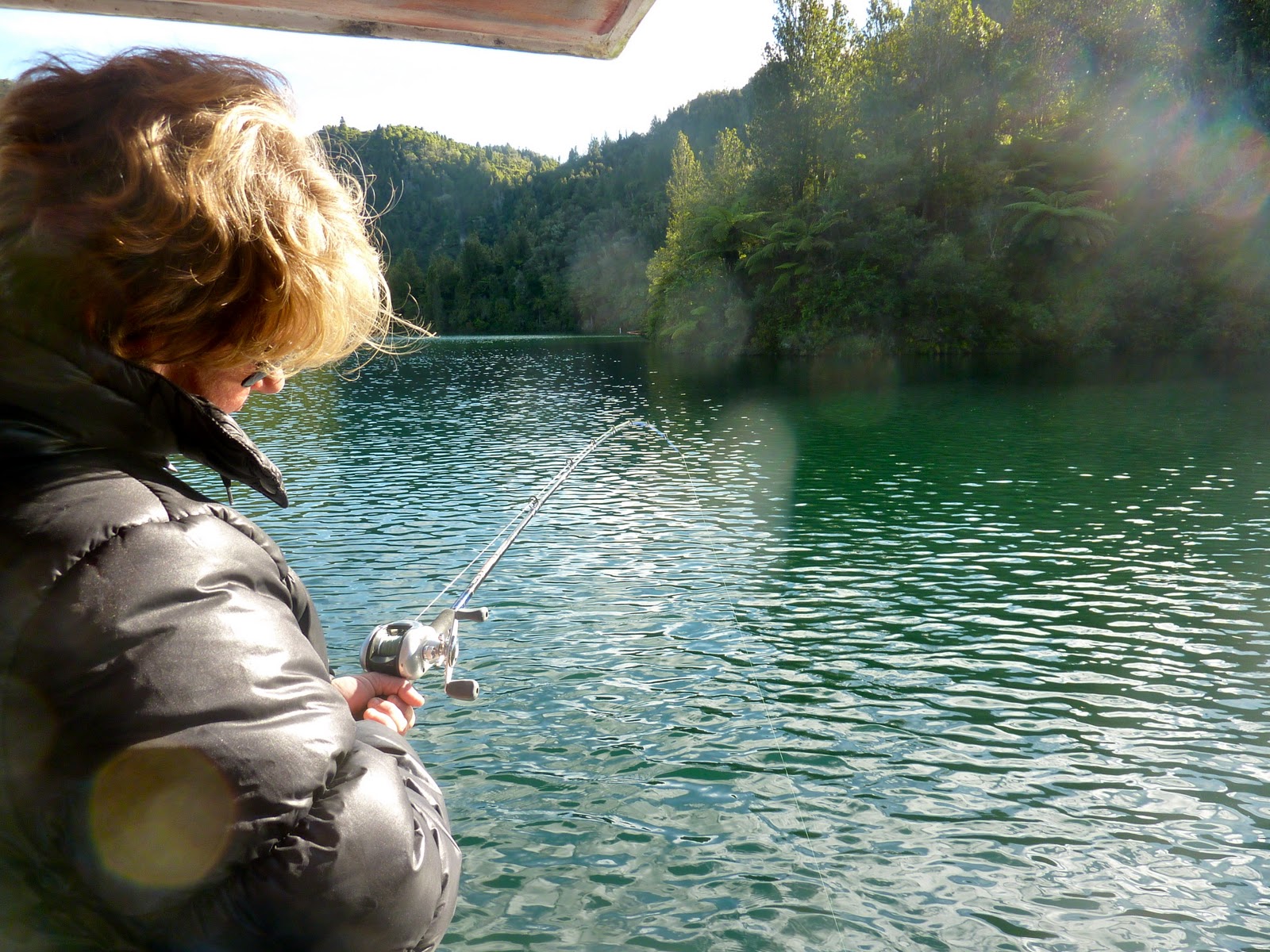
 “The fishing trip was a highlight for me. Fish are not on my list of favourite things and I am quite amazed with myself that I spent nearly all the time out the back with a rod in my hand, would have dropped it like a hot potato if something came on it!.”

“Yesterday was the first time I had been fishing, so now I have gained some skill and knowledge”

“It was so relaxing to be fishing on this lovely boat, a real opportunity to quietly reflect and to be in the moment”.


 There were challenges with the fishing as well! We did manage a fairly major tangle!!!

We travelled across the lake and spent time in different parts of the lake. The peace the tranquility....

“The lake was so quiet, apart from two kayakers we saw no one else on the lake over the four hours we were exploring and fishing on the lake, wow, such peace. It was so beautiful”.


Some took opportunities to get up on top and enjoy the view!


Inside the boat more opportunities to share and chat

 “It was cool to be able to just sit around on the boat, in such a beautiful environment, just enjoying the peace and tranquility and the company of others.”

Saturday night dinner was a celebration! Fish philosophy in action. A time to play and be a little creative!
“The props at dinner added fun to the night and shows that as adults we find dressups fun too!”
“ Fabulous food and a wonderful celebration, such a treat!”


“ All in all this retreat has been an amazing weekend filled with laughter, talking and friendship. As a practitioner I have been provided with an opportunity to engage in numerous professional discussions, be creative and reflect on ‘wise practice’. Thank you”

“Being near water this weekend has been healing. I have enjoyed being part of a group of like minded people who have this common bond and purpose. Listening to the korero lead me to think about my journey - kia ora. Having time on the lake gave me time to ‘be’. I don’t get much opportunity for that, so it has been a weekend of reflection, rest and connecting. Thank you for making it possible.”

“I have discussed this weekend, the things that make me who I am. I have enjoyed the fellowship of my colleagues and felt accepted as part of the group. I have felt supported on my teaching journey in a way that I some times miss in my professional life. I have felt my ideas and feelings have been valued. I have learnt from listening and talking with others.
I will take away with me further knowledge and an increased confidence in my ability to find further learning from a variety of areas around me, people, reading etc. I aim to read about learnt optimism.”

“It has been a very relaxing weekend, with a variety of activities. I thoroughly enjoyed my morning walks with my friends. Can’t remember when I have laughed so much and for so long. The venue was superb, fantastic choice, Okataina has certainly lived up to it’s name (place of laughter).”

“Beautiful setting, beautiful people - ka pai .... Whakawhanaungatanga is very present at Okataina.”

“Food, company and new learning has been wonderful and as I sit here looking at the photo’s of this weekend moving across the screen in front of me, I feel lucky to have had this opportunity to have fun, share ideas and just come together. To Wendy and Alison, it was a privilege to listen to your wise words and  to be treated to such a special time..thank you.”


Friday, November 4, 2011

‘Through the Looking Glass … a Lens on Quality Preschools’

It was lovely to be invited by the Early Childhood Unit for the NSW Department of Education and Communities to present a keynote and also facilitate a workshop at the conference. This conference was titled ‘Through the Looking Glass … a Lens on Quality Preschools’.


 The second day saw a range of workshops facilitated by the following people and a few others.....
My keynote was entitled Sustainable Leadership: A time to reflect, re-imagine and to reconstruct’ and the workshop was titled ‘Pedagogical Leadership: A powerful opportunity to build learner identity via ‘learning story philosophy’.

 
The work was enthusiastically received, some of the comments sent from the organizers following the conference included the following:  
“Participants all agreed that your presentations met the highest possible rating and their comments supported these ratings. I have added a small sample of these for you as follows:

It is so good to be reminded of the importance of positive interactions.
Find the magic... I loved that. I am making it my new philosophy/goal.
This presentation was so thought provoking and powerful making me think about how/why I work with
young children. 
I love Wendy’s stories that she uses to build relationships.
I love the slow schooling theory...a real inspiration.
This was first class...a real joy. Fantastic content and presentation.
Thought provoking!
What a wonderful keynote speaker..

Thank you for helping early childhood teachers have a voice- promoting the child’s strengths and interests, not a K-6 curriculum push.”

After the two day conference. We (Dave and I) went on to have a lovely weekend in Sydney. See photos of this on my personal blog http://wendyelp.blogspot.com

Thursday, October 20, 2011

She is worth pursuing, the fabulous Alison Gopnik


Hope you are all taking time to listen to this TED talk by Alison Gopnik suggested in the last blog. Here are some more reasons to listen to her if you are not yet convinced!

 
This video also has an ‘Interactive transcript’,this means you can click on any part of this transcript and the video will start playing at that point! Here is a little of the transcript below. Go on to the TED.com site and try this out!

You will also find fabulous comments from others about the blog, here is one from Robert Johnson
The idea that we should teach more (and babysit less) in very early childhood is, IMHO, totally correct. I have observed and believe that nearly all children are born "geniuses" and we teach them to be "dumb". Dumb in the manner of parroting and repeating, often by rote, what is taught. We grade children on what they regurgitate rather then their ability to observe and think. I totally agree that teachers of early age should have more training and more money. Children are brilliant individuals and it is a shame to waste (for the most part) that potential."

Also have a look at Alison Gopnik's website  http://www.alisongopnik.com/


On this website are a number of interesting links to her books, papers, research and a range of other videos to listen to.