Thursday, August 27, 2020

Sir Ken Robinson was a beacon of hope for all who believe in the power of playful education


The death of Sir Ken Robinson on 21st August 2020 was a devasting loss to the global education community. He was an extraordinary educationalist whose commitment and passion for being responsive to each child, and for recognising what he called ‘their element’, was so in tune with our own Early Childhood Education curriculum, Te Whāriki. He encouraged all of us to be attuned to the child, their spirit, and their passion.  Sir Ken Robinson, like those who developed Te Whāriki, had a vision of what education should look like. He challenged so much of the educational past that many of us have experienced. His work was and is transformational for both teachers, children and families alike.


He drove an educational revolution that challenged the industrial models of education that are still pervasive across our educational systems: the models that do not put children at the heart of education but rather systematize  everything in the interests of accountability rather than education. It is the standardization of outcomes, testing, and goals that move teachers away from the heart of teaching, stifling the critical notions such as the importance of being in relationship with children.


His talk  ‘Do schools kill creativity’, is he most watched TED talk of all time. It has had more than 66 million views….. what follows is a little excerpt from this talk…


“Our education system is predicated on the idea of academic ability. And there's a reason. Around the world, there were no public systems of education, really, before the 19th century. They all came into being to meet the needs of industrialism. So the hierarchy is rooted on two ideas.


Number one, that the most useful subjects for work are at the top. So you were probably steered benignly away from things at school when you were a kid, things you liked, on the grounds you would never get a job doing that. Is that right? "Don't do music, you're not going to be a musician; don't do art, you won't be an artist." Benign advice -- now, profoundly mistaken. The whole world is engulfed in a revolution.


And the second is academic ability, which has really come to dominate our view of intelligence, because the universities design the system in their image. If you think of it, the whole system of public education around the world is a protracted process of university entrance. And the consequence is that many highly talented, brilliant, creative people think they’re not, because the thing they were good at at school wasn’t valued, or was actually stigmatized. And I think we can’t afford to go on that way.”


For those who have not read the work of Sir Ken Robinson, now is the time to explore this work. Here is a list of this books… You will not regret picking up these books:The Element; Out of our Minds; Creative Schools and You, Your Child, and School.


There are also many opportunities to listen to Sir Ken Robinson … a google of his name will bring up over 16 million links…. Start with his TED talks...

Sir Ken Robinson died on the 21st August surrounding by his family after a short battle with cancer. For many of us, we were shocked to learn of his death. I know he has inspired me through his deep commitment to children across the globe, delivering his powerful messages with such an uplifting and witty delivery, always leaving me with a feeling of incredible hope and possibility. He will not be forgotten.

 Aroha mai, Wendy Lee


Friday, June 5, 2020

OUT MY WINDOW


A Learning Story from Christine Carducci, EdD
SALSA Board Secretary
(Supporting the Advancement of Learning Stories in America)


I can't believe that it has been close to two months from April 6 when I wrote this story, below, and even longer from when the stay at home order was announced (March 16). I am thankful for the educators and colleagues who took time to read and respond to my story.  I am fortunate to have this network to reach out to and thankful they always respond.  

In regard to what's happening 'out my window' now.  I am left wondering about the children and families in my neighborhood.  The first few weeks of physical / social distancing, the time when I wrote this Learning Story, there many families and children walking by.  I noticed them and enjoyed their presence in my space for the few moments when they walked by and walked on.  Yet over time, they've stopped coming.  I don't often see or hear children walking with their parents as much outside my window. Seems things are changing back to how it was before. Outside my window now, I hear voices of 'work-from-home' cell phone conversations as adults come and go from the re-opened coffee shop mobile order pick-up in hand.  I hear occasional families on bike rides or those walking dogs. I wonder if the children are occupied at home,  going out to different locations or walking different streets?

Then, I wonder, what was it in that moment in time when children and families were spending time together walking in the neighborhood? What was it about me, in that moment and time when I was alert to notice, to pause, to reflect and to appreciate their presence. So, I continue to reflect on the question: What good may come out of living through an international pandemic ? 


Out My Window 
By Chris Carducci April 6, 2020 


This story begins on Friday March 13, the day I realized that everyday life was about to change. And change it did – in a big way. My sister and I had planned a trip to visit our parents in Nevada.  Friday, March 13 we cancelled our visit due to scare of coronavirus and wanting to be cautious of being in public social settings such as airports, lyft rides and inside the retirement community where our parents reside.  That left me home.   

On Monday March 16,  Six SF Bay Area counties were ordered to shelter in place - advised not to go out except for “essential business” and told “Wash your hands. Don’t touch your face, Don’t get close to other people.” It was all very scary and surreal.  I went to bed and stayed there.   

A few days later, as the shock, uncertainty, and disequilibrium settled a bit, I decided I needed to snap out of it, get out of bed, get up, get dressed.  I was one of the fortunate who could work virtually from home, so I took action.  I moved my home office from the back part of my apartment to the front room by the window.  Here I discovered joy out my window.   

It was the sounds of children laughing. Families were taking walks in the neighborhood. Children  who would otherwise be driven to child care or spent their days in school were out on my street. I first noticed one day after a morning of rain, children wearing bright yellow rain boots and splashing in the lake-sized puddle out side my window.  As parents captured the moment on cell phone, I grabbed my camera also to retain the joyful moment and share via text with my friends and family :) 


After this first experience, I came to welcome your presence in my day.  Many times, I would hear and see you walking by my window. Dad and boys; calling out, running, laughing, walking together hand in hand. 


Over time, I noticed more families outside my window. These children discovered my neighbors ‘fake grass’ was the best place to drive a remote control car.  I wondered to myself, how often you actually played with this toy? Was it a long forgotten gift now pulled out of a closet because of the shelter in place order? Or were you drawn to bring it along on a walk because the house was getting too small for driving cars for a distance at high speeds?  I fondly recalled the days when my now teenage nephews used to play in such ways. 


One day I noticed a little toddler enthralled with the classic “peek-a-boo” hiding game in the bushes outside my window. It touched my heart to watch your adult play with you in this way for quite awhile until you moved on down the sidewalk and she followed pushing the empty ‘just-in case you need it’ stroller. Nature offers such an abundance of opportunities for spontaneous interaction and play. I wondered if this was your first time down my street or if this spot was  a part of your routine walk and it was my first time to notice you because I didn’t often spend time looking out the window when working from my home office seated in the back of the apartment.  


What Learning is Happening?

I recognize how much I relate to children’s development and learning through everyday experiences. The educator part of my brain is reaching to label my observations of the children in the context of assessment. Both New Zealand’s Te Whariki strands and CA DRDP outcomes are evident in these observations. Without going into details of what learning may be happening for the children, suffice it to say that there are many, many connections to child assessment happening in everyday experiences at home with family and neighborhood walks. 

We are all learning about how resilient we can be in the face of extreme difficulties. These families are doing the best they can to cope. They are making time to get outside and offer the children a change of environment and some exercise. This is significant to mental and physical health. I do not know any details of the families’ context or situation that brought them to be walking down my street when they did – I only know that I am extremely fortunate to live in the neighborhood that I do, where it is safe, clean and welcoming for families to walk. I do not take this for granted and I recognize the privilege of my social class status and to be living in this way.

Opportunities and Possibilities

My first thought is to respond in a more global perspective. I pose the inquiry question: What good may come out of living through an international pandemic ? After the shock of change more or less resolves, and people come to feel a ‘new sense of normal’ what behaviors, values, routines, and practices can be kept which promote more humanistic practices and policies?

What about the environment? With fewer cars on the roads and factories not producing materials in abundance – has the earth been given a respite from environmental pollution?

What about technology and education? Where there was great inequity of access to digital devices and internet – some companies and government stepped up to provide to many (though not all) who did not have such. This was the solution to the problem faced because of the decision to close physical schools and from pre-school through college, virtual schooling from home was initiated. Many educators were faced with really questioning the purpose and practices of their curriculum structures. Thus, another inquiry question: What good might come from an intentional ‘pro-active’ look at this re-active solution to create more effective and
equitable education structure in the 21st century?

It may be my desire to stay positive and optimistic in an outlook of a hopeful future resisting against the news and negativity of dread coming at me from television, radio, internet and email boxes. The joy of the children walking down my street, which I see out my window, gives
me hope. Writing this learning story has helped me to be reflective and thoughtful and for that I am thankful.

Perspectives of others: 

As I share this Learning Story with friends and colleagues I will include their thoughts and reflection here. I am most interested to hear others’ thoughts on connections from the children outside my window and their stories to the larger global issues of equity, humanity, and sense of place in these trying times.


https://www.elp.co.nz/files/Responses_to_Christine_Carducci_Learning_Story_Out_my_window_www_elp_co_nz.pdf 


Tuesday, June 2, 2020

A message from Kazakhstan

It was so lovely to hear from Altyngul Taibassarova. Altyngul lives in Astana, now Nur-Sultan the capital of Kazakhstan. She is currently involved in establishing a new kindergarten 'Abadan Kindergarten and Family Centre' which will have three languages of instruction (Kazakh, Russian and English). 

She writes "It is very challenging time for the whole World. It is difficult not to see your friends, colleagues, notable to go out whenever and wherever you want. However, working from home has taught me to be even more caring, loving and patient. I spent a lot of time with my family and I loved it. Seems like the Earth gave this chance to everybody to reflect on their lives. COVID_19 has also brought very quick transition into digitalization. All that seemed far and not real, now is possible. We have learnt to adapt quickly. And that is very good".


Monday, May 18, 2020

COVID_19 SAN FRANCISCO: REFLECTIONS AND INSIGHTS FROM ISAURO AND BEYOND

Isauro has agreed to share this very moving sequence of both his thoughts and feelings during this time, his COVID_19 focussed Learning Story and the beautiful responses from friends and colleagues around the world. This documentation is both poignant and powerful and I am deeply grateful of his courage to share his vulnerability and insights at this time. Isauro, muchas gracias, abrazos, Wendy
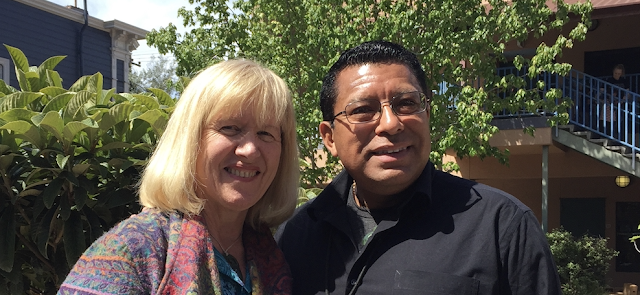
Wendy and Isauro at his school in San Francisco 2019
I hope this email finds you well. I am sharing the Learning Story I wrote last month with the many insightful responses I received from early childhood educators near and far. Please, read it and see if there is a quote there that resonates with you. Or  perhaps you'll find something worthy in this email.

As it turns out, my Learning Story encouraged others educators to reflect on their own reactions to the Covid-19 impact and their stance on distance learning for young children and those responses help me to realize that I belong to an early childhood community of thought leaders all over the world. The responses came from as far as Morocco, Hawaii, and New Zealand.

What I have learned from educators in New Zealand is that a Learning Story narratively intertwines the personal with the professional to highlight specific events that happen in the classroom or school settings with children. Teachers write these Learning Stories to create records or children's learning and growth over time. The children's family are usually the ones who respond to the story. In my case, those responses came from colleagues, professors, teachers, and educators who deeply care about children, families and other teachers. 

Isauro outside Grace Cathedral, in San Francisco, which has remained closed since mid- March 2020.

The Learning Story I shared with you and a few other educators captures what I was feeling at the time I wrote it.  Prior to writing the Learning Story in times of Covid-19 I had shared those feelings in one our online class meetings with my professors and classmates. Talking about it was quite helpful, but the process of writing a Learning Story gave me the space and the framework to organize and label my thoughts and feelings amid the chaos brought upon us by Covid-19. More importantly expressing my thoughts and feelings in a Learning Story helped me to open up my heart and mind to multiple ideas, opportunities and possibilities. Learning Stories humanizes education in ways I never thought possible. 

From a pedagogical perspective Learning Stories serves as an educational tool for teachers to reflect on a problem of practice and engage the immediate community or the community at large to get a better understanding of an issue, event, problem of practice, or question(s) impacting our profession and teaching practices. I'm forever thankful to educators in New Zealand for giving us this gift. I am also very grateful to each person who responded to the Learning Story I wrote because their heartfelt responses captured many differing perspectives, all of which helped me to get to a point where I can function better and engage critically with the important work I have at hand.  

Currently, my work as an early childhood educator is to engage with children and families in a way that incorporates policies on distance learning put in place by the San Francisco Unified School District, the California Department of Education, and protective safeguards created by the teachers' union (UESF-United Educators of San Francisco). Our responsibility is to pay close attention to what is developmentally, culturally, and educationally appropriate for young children in regards to "distance learning" and to keep a sense of connection and community based on their and our emotional wellbeing.  

Reading the entire Learning Story with the responses and replies from my community helped me in my own emotional growth and understanding of my stance on distance learning with young children. Now that I feel more emotionally grounded I can process things more clearly and I'm more engaged in the work I'm required to do as an early childhood teacher with children, families and other teachers in the midst of the Covid-19 pandemic. 


The way the early childhood community responded to my Learning Story with so much empathy, compassion and understanding in the midst of the Covid-19 health crisis gives me the encouragement to share this Learning Story with others educators. 

Thank you so much for allowing me to share this Learning Story with you. I'm also including a few photographs in case you need one to go with the quote. I took these photos just yesterday in front of the Grace Cathedral, here in San Francisco, which has remained closed since mid- March 2020. 

Best, 

Isauro 

Isauro M. Escamilla 
Early Childhood Educator, San Francisco Unified School District 
2016-2020 NAEYC Governing Board Member 
Ed.D Student in Educational Leadership, San Francisco State University


The Learning Story from Isauro follows:


Stepping out of my Comfort Zone and Facing COVID-19 Fears 
Isauro M. Escamilla 
April 16, 2020 
San Francisco, CA 

Getting up!

What happened? What’s the story? 

Today, three weeks have passed by since we were instructed to shelter-in-place to avoid people and hopefully, escape the deadly corona virus. Like almost every morning I look at my face in the mirror and what I see is the worry in my eyes, the sadness, the sleepless nights, the dark circles that are slowly making themselves feel at home on my face and that fortunately, I can kind of cover up with my prescription glasses. 


Ready to go out

Going out into the mostly empty streets makes me feel anxious and fearful. Stepping out of the safety of my small controlled-rent apartment in the city is like stepping out of my comfort zone to face an invisible monster. For double protection. Hiding under a disposable face mask, I covered my mouth and nose with a hand-made mask I sewed myself during a sleepless night. Wearing disposable plastic gloves which I believe offer stronger protection when worn with my rosary and a prayer, I ventured out to catch the bus to go to our empty preschool. 


Today, is the day the school district decided to hand out materials to all the preschoolers. And teachers Sahara, Edwin, Nadine and myself offered to be on site and personally hand out the learning packets to families. These packets include 51 double-sided pages with activities for parents to do at home with their children, a couple of story books, index cards, a notebook and color pencils or markers. Perhaps next time we could also include, playdough, beads, puzzles, watercolors, big buttons, glue, masking tape, and open-ended stuff to put together and break apart as many times as the children wish. The families started coming in at 10:00 AM and almost every 10 or 15 minutes a new parent approached the school gate, where we had placed a table to avoid coming into close contact and keeping a distance of two meters or more between us. Between smiles, saludos y bediciones (greetings and blessings) the parents expressed how much they missed us and how much the children wish they could be at school. 

Paul’s mom told us that he asks everyday why he can’t be taken to school and that sometimes he gets angry. Vladimir’s mom shared that he asks about teacher Sahara very often and once in a while, he also asks about me and teacher Alicia. Dulce’s mom expressed that her daughter really wanted to come with her to pick up the materials, but all parents followed the agreement for only one adult to come by without children, and keep them safe at home. If the children had accompanied their parents to stop by the school, I am sure they would have run to us and given us a hug, even if they had to crawl under the table. It would be hard for them to stay away. I can certainly see Paul running to us and asking us where we have been! I could almost hear his laughter! The children don’t understand that we must stay at least six feet apart - keeping roughly two meters, between us. Today, we did not meet the children. We only met one adult from each family, either a mom, a dad, or a grandpa. And it was nice to see them. 


What does this story mean? 


With covid-19 cases approaching 1000 and with 15 deaths in the city, it is crucial to stay indoors. However, someone had to hand out those activity bags to parents. Teacher Edwin had volunteered to drive throughout the city and drop off the bags at their homes, but something happened at the last minute and he could not do it. 

It was quite nice to see teachers Sahara, Edwin and Nadine, and our Principal Ms. Hoshino at the school. We diligently kept our safe distance and wore our face masks and gloves all the time. Parents seemed very appreciative and expressed their gratitude for the work we do on our regular school days. Maryah’s dad jokingly said that he now appreciates each one of us even more than before. “How do you do it? Watching these kids all day long, day in and day out is not easy. It’s hard work!” He exclaimed with a puzzled look on his face and a grin that made us realize he was serious when he asked that question. 

But, what does it all mean? Perhaps it means that we need each other now more than ever, and that we need to do our best to respect the physical distance and stay-in shelter rules so that once again we can all be together at our school yard some day. Today, the school yard, as clean and colorful as ever, did not feel right. Even the plants, although in full bloom, have a certain sad energy this spring. As I usually do, I took a few photographs, which I’m sharing in this story. Our schoolyard, as many others around the world, was missing the hustle and bustle of children coming and going, running and skipping. What was missing in the schoolyard was Paul’s laughter, Vladimir’s mischievousness, Dulce’s shy and sweet smile, Anna’s never-ending questions, and Elizabeth’s beginners’ jokes, the ones that only a witty five-year-old girl is able to say, understand and laugh at, even if nobody else gets the joke. 


The Lonely Schoolyard


What opportunities and possibilities do arise?

What I see perhaps, is the need to step again out of my comfort zone and reach out to families via Facetime or any other app to connect with children, but to do so without the constraints of a formal lesson plan. It is admirable that some teachers spend so much time planning a full day of adult led-instruction and activities to fill each day of the week to the minute, while the children are at home with their families. I remind myself that parents are the children’s main teachers and from whom they can learn as much as - or even more than, they will ever learn with or from me. But those are the expectations of distance learning, remote learning or online learning. I really admire those teachers who sing, dance, read and hold circle time on live video. I wish I could feel that comfortable and transmit that much charisma and happiness on the screen. It is not that I do not try. I do. I take a selfie once in a while, like the ones at the start of this story or do a mini video for myself and what I see is simply pathetic.

When I see my face in the mirror or on my iPhone what I see is the anxiety lines, the uncertainty marks and the huge weight of children’s education on my shoulders, which is both in and out my hands. With so much apprehension in my heart, singing De Colores for children and families in front of a camera is not the first thing in my mind when I wake up in the morning. Lately, I must confess, I do not feel like singing, clapping or putting on a performance. Lately, I do not see days in many colors; it is as if everything was covered in tones of grey. If I could share something with parents, I would tell them that what they are doing at home with their children is perfectly fine. If they feel they would benefit from having a daily schedule or the most recent activity on the Khan Academy app, they should do it and if they feel they do not need them, then they should not do it. Parents know better than anyone else what their children enjoy and what they do not.

Many families, out of need, usually drop off their children at the preschool at 7:30 AM and don’t pick them up until 5:30 PM. This is an opportunity to spend family time together and have a good time cooking, sharing meals, doing household chores, while singing or dancing to their favorite songs. They do not need me or an app for that. On the other hand, perhaps the children would like to see us, their teachers. Even more, perhaps if I see the children’s smiles, hear their voices, laughter, simple jokes, and never-ending questions, I would start to see my own days in color again. Perhaps, the children will not notice the worry and the fear in my eyes, the dark circle under my eyes or the ounces of gel I now have to apply on my hair to tame it for lack of a proper haircut. Perhaps, they will only see a teacher who cares about them so much, that is willing to step out of his comfort zone to show his face on video if only for a few minutes a day to say or sing Hola amigos, ya salió el sol, vamos a cantar y hablar en español…And perhaps, little by little I would recover the sense of hope in my heart, the laughter in my soul, and the sunshine in my day.


Spring blooms at Las Americas Early Education School


The following is a link to all the heartfelt responses from many friends and colleagues around the world....


Friday, May 15, 2020

COVID_19 CALIFORNIA : A MESSAGE FROM ANNIE

I have been impacted by COVID-19 is several ways. As a university instructor, abruptly, I lost all face to face contact with students to embark on a new journey with weekly online Zoom class meetings.
Zoom class meetings
It has been tricky to hold space and still deliver academic content for the students' who have faced so many challenges. I have tried to find the fulcrum as I have endeavored to balance listening, caring, providing resources, all while trying to humanize online instruction.


The space between my lap top screen and their device feels so far away.  I have had students who have lost housing, living in their car yet, show up for our online class from their vehicle in a parking lot so they could access free wifi. I have had students who have lost jobs, unable to buy food, or lacked appropriate devices to be able to complete their school work, or didn't have internet and sat on the porch of a neighbor's house who graciously allowed them to access their wifi so they could attend online classes.
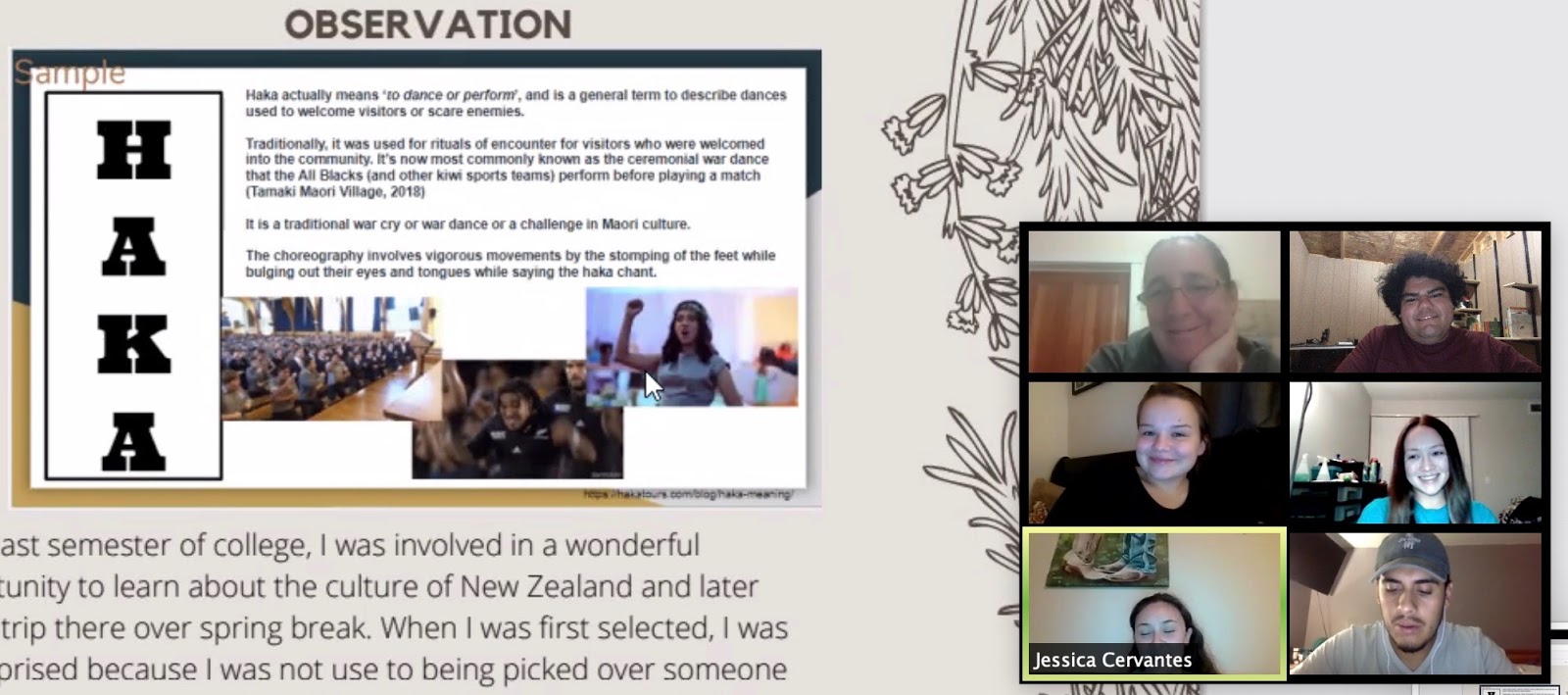
Sharing a little of Aotearoa New Zealand in their zoom meeting
Every time a student doesn't show up for the weekly online class, a sense of fear overwhelms me. For each response reveals burdens, struggles, sickness and sometimes death. When these students do not show up for the scheduled weekly online Zoom class, I reach out with persistence (maybe a little like stalking) through email and text to see if they need support. I found out one student didn't show up to our online class because they had been in the ICU for 5 days on a ventilator. And yet, the following week, their face was shining bright across the screen. The student's father walked into her bedroom during our Zoom class, and in front of all the other students, with tears in his eyes, thanked me for calling and checking up on his daughter, as it showed how much I cared as a professor.  I have had several students lose grandparents and relatives to COVID -19. And so many more afraid for the health and well being of their families and friends
Graduation Day at University
Yet, with all the uncertainties we face for the future of higher education, I have found a deep sense of gratitude for my university, colleagues, students and community. I have seen my university provide resources for students who are in financial need. For example, I was able to refer the student who was living in their car to the university CARES team who was able to provide funds for the student to get stable housing. Others have accessed funds to purchase food, pay utilities, etc.  Also, I have seen students give back by serving their community online through answering emergency hotline phones, reading books to children, translating text into multiple languages, calling elderly who are alone, and so many more ways. It has made me proud to be a part of something greater than myself.
Annie White, Brenda Soutar and Wendy Lee at the California State University Channel Islands
As we are nearing the end of this semester with financial loss and the fall semester instruction delivery method unknown because of COVID -19, I have been provided the gift of time, to slow down, and listen more deeply to others, lean into the uncomfortable silence, embrace the shadow and light that surround me. Though the Zoom online classes will come to an end, perhaps in the fall, or possibly later, as the screens go dark, the students will never fade. Their stories will linger, as we all hope to move forward in the future, to a time where we can look back at the past without staring.

Much love to you all
Annie

Annie White, Ed.D.
Assistant Professor of Early Childhood Studies, School of Education
California State University Channel Islands

Monday, December 9, 2019

Culture, language and identity: children’s stories woven with teachers’ stories in a bi/multicultural curriculum

An article by Mihaela Enache

November 2019
______________________________________________


Titiro whakamuri kia anga whakamua.Look to the past in order to move forward. 
(Maori whakatauki).

To be yourself in a world that is constantly trying to make you something else is the greatest accomplishment
(Ralph Waldo Emerson).

Our identity is like a stake in the sand
(Melinda Webber, 2014, private conversation).  

In an increasingly globalised world, it becomes imperative for teachers to honour children's individualities, their identities and cultures. One approach to this complex task is through the power of storying, of listening to, telling and writing stories..... 


Mihaela Enache has just published a new article we would love to share with you, as a result of her presentation at Educational Leadership Ltd's Celebrating Learning Stories Conference in October 2018.  This article was inspired by Mihaela's PhD proposal on (immigrant) teacher identity. 

Mihaela Enache is a PhD candidate at the University of Auckland. To read the article please visit our website: https://www.elp.co.nz/articles.cfm.