Monday, February 2, 2015

Verity Johnson: Bad parents? These people are heroes

This is an opinion piece that was in the NZ Herald just before Christmas. I think it deserves to be read by a wider audience.  Verity Johnson says we need to rethink the way we talk about poverty, forget the prejudice and deal with some of the uncomfortable facts about what is happening in the homes of the 'underclass'. 


Here is the link to the story  http://www.nzherald.co.nz/nz/news/article.cfm?c_id=1&objectid=11377064

I will also publish it below...
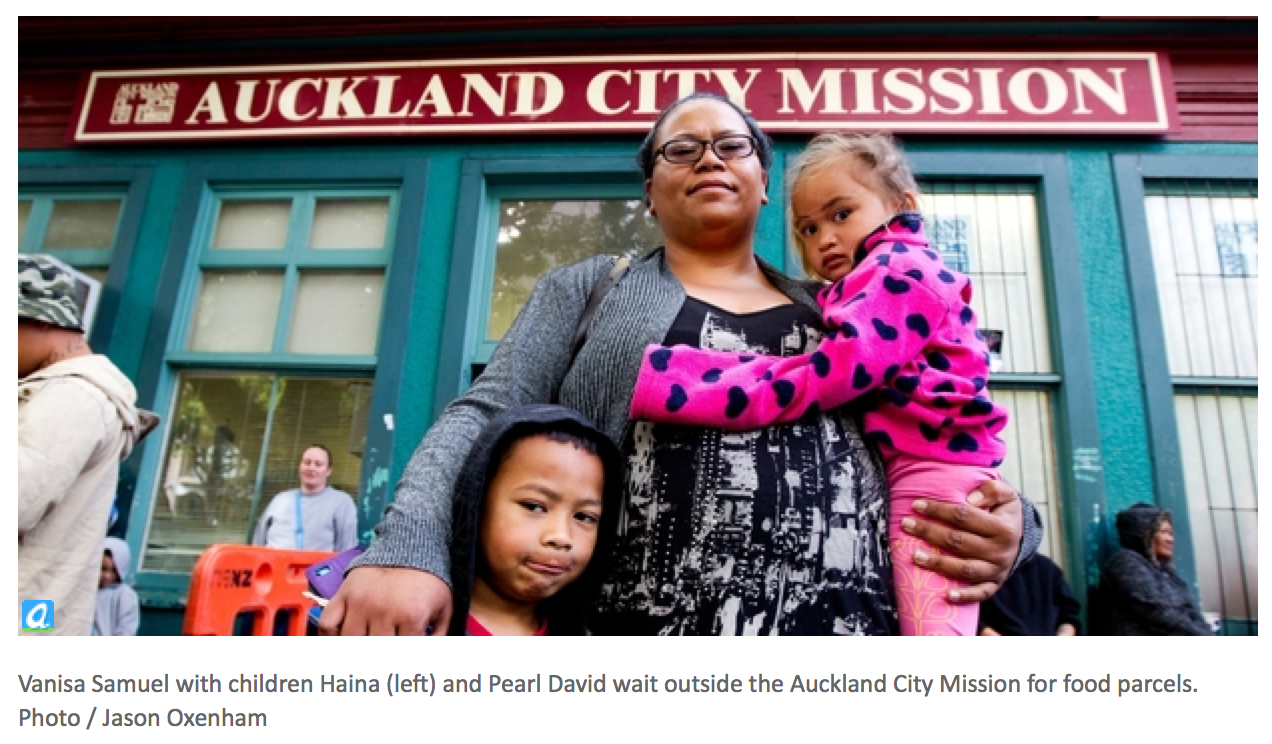
I was running, Hop card in my teeth, clutching my bag, pulling down my skirt and blinking away sweat. I was late. I was lost. And I'd forgotten to Google where Auckland City Mission actually was. But I needn't have worried. As I turned on to the corner of Hobson St, I froze. About 200 people were standing on the pavement.

It was the queue to get into the City Mission.

There was a TV3 guy in a sharp suit at the end of the line. He was trying to talk to people and was getting laughed at. I had to walk past him, and through the queue, to get to the door.

I've never felt younger, greener ... no, whiter, and more middle class than I did at that moment.

Inside, people were squashed into every corner. People sat hunched, elbows on knees, staring at me, or at the wall, or at the clock.

At my feet, a baby girl with dark curls wriggled around like a caterpillar.

I looked at her. Then I looked at my feet. I was wearing new trainers. I'd bought them yesterday. $180. A Christmas present to myself. White, high-heeled Nikes. They glistened like pig fat under the neon lights.

Eventually, when a bead of sweat had dribbled the full length of my spine, I got shown into Diane's office.

Diane Robertson, CEO of the Auckland City Mission, looked busy. She had one food parcel to distribute every eight minutes. She waved away my feeble small talk about the heat, pulled out the Family 100 Report on poverty in New Zealand, and talked for the next hour about the hideously intricate web of poverty.

I left. My stomach was tied in fierce knots at my own privilege, the injustice of the situation and the fact that some people had queued since 3am. There was still a queue at midday. They were waiting for a box of Weetbix, sausages and toilet paper.

Later that evening, I was in a funky Takapuna bistro for my girlfriend's birthday. It was one of those places where everything comes with an artistic olive. It was one of those places I felt comfortable walking into. One of those places I could wear the white trainers in.

It was also the place where I'd had one of my most heated dinner conversations ever. A guy had been telling me that we shouldn't have free breakfast in schools. Apparently parents who sent their kids to school without breakfast were irresponsible. If we gave them Weetbix, it'd only encourage this bad parenting.

The idea that poor people are bad parents is one of the ideas I heard a lot at school. It normally came alongside something like, "God, they just laze around, sponging off the government, living off benefits ... they don't even want a job."

There is prejudice and loathing, and then there are facts. The Family 100 Project, an online report compiled by Auckland Council, Auckland City Mission and Think Place, brings the truth of what's actually happening in the homes of the underclass.
You'll read, in story after story, about parents who don't eat so that their kids can. Parents who don't sleep in a bed so their kids can. Parents who will get up at 3am to queue, go through a five-hour ordeal of form filling, waiting, explaining, waiting, explaining again and waiting again ... just to get a box of Weetbix and sausages so their kids can eat at Christmas.

They don't sound like bad parents. They sound like heroes.

And when you read The Family 100 Project, you'll see there is a section on employment. You can read the interviews where people rhapsodise about working.

They want to work; it's a ticket out of poverty. It's a way to meet new people. It's a way to buy dinner every night of the week. And it's a self- confidence boost.

They don't sound like spongers. They sound willing, no, desperate to work.

And you can see the web of agencies that people living with poverty deal with in a fortnight. It's well over 20. Families must traipse from agency to agency, continually proving how they're 'legitimately poor'. I can't imagine what that's like. But it sounds like they work flat out to live.

We can do something about it. We can change the way we talk about poverty. We can donate to Auckland City Mission's 'Be Someone's Angel' campaign. Or we can think better of buying $180 trainers and buy two food boxes for a family instead.

I'm not sure I want these shoes now anyway. I thought they were a sparkly white. On closer inspection, I think they're a foul yellow.

Monday, December 8, 2014

Linda Mitchell: Put children's education before shareholders

This article is available on The New Zealand Herald site -http://www.nzherald.co.nz/nz/news/article.cfm?c_id=1&objectid=11367139


Government early childhood education (ECE) funding and parent fees intended for children's education will pay for the dividend yields of 4.69 per cent and $16.6 million profit forecasted by Evolve Education Group as it buys up early childhood companies Lollipops Educare and Porse.

Government funding includes the 20 Hours ECE intended for children to attend ECE at no or minimal cost. The Evolve Education Group prospectus is quick to point out that 20 Hours ECE "can earn additional revenue" through optional charges.


Termed "an attractive investment opportunity", "childcare" is conceptualised as big business, selling a commodity to parent consumers as they participate in the workforce. Attractive images are used as selling points but the Evolve Education Group Prospectus foregrounds profitability - its first duty as a listed company is to shareholders.

Children and their learning and development needs are largely invisible; families are purchasers of education.

This main interest from a commercial view in making profits for owners or shareholders, positions Evolve Education Group at odds with more community spirited aims to invest fully in the service itself.

And the intention of Evolve Education Group to increase its scale "through selective acquisitions" will undoubtedly see it targeting high-income communities and those low-income communities where government is investing most money, i.e. areas where profits are easier to make.

Profitability is a key selection and acquisition criteria. A recent OECD study of 20 countries has shown that a reliance on privatised provision of early childhood education will almost certainly lead to inequities in provision in poorer communities because commercial providers are reluctant to invest in such communities.

The spectacular example of the rise and fall of the publicly listed Australian corporate childcare company ABC Learning should be a warning to us.

Following rapid expansion ABC became the largest corporate childcare provider in the world. ABC encouraged its staff to hold shares in its business, thus tying them into its corporate values. In this way, the values of business owners may start to overshadow public and democratic values that are embedded in community based ECE services.
The spread of ABC Learning in Australia had the effect of limiting parental choice of service and putting non-ABC centres at financial risk. It swamped ECE provision in some communities as it squeezed out the community based sector. Australian researchers have documented its rise, subsequent fall and suspension from trading, when the Government had to pour in A$56 million ($60 million) to cover operating costs while a buyer was found.

Professor Deborah Brennan termed ABC "a vast, unprecedented and unsuccessful experiment in Australian [early childhood education and care] provision". Its outcomes were described as "costly and dysfunctional".

We need to get back to fundamental questions about the values and aims for early childhood education, about who should benefit, and about how it should be provided. Surely not first and foremost as a business opportunity for the benefit of shareholders.


Linda Mitchell is Associate Professor in early childhood education at the University of Waikato.

- NZ Herald


Government funding includes the 20 Hours ECE intended for children to attend ECE at no or minimal cost. Photo / Thinkstock              

Sunday, October 26, 2014

The Journey

I was reminded this weekend about the importance of the journey rather than just the destination.  My mokopuna Flectcher (9),Taylor (6) and I decided to go for a walk to a local harbour beach and the island that is accessible only at low tide, Motuopuhi Island.  According to Google Maps this is only a 17 minute walk but what does Google know about the journey rather than the destination.
As we walked, at a very slow place, we discovered hidden treasures amongst the rocky shore - a soccer ball, a tennis ball, sticks that could break others that could not, some that could be weapons and taiaha and all varying lengths and density.  Each time we slowed and looked deeper into the rocks I reminded myself it is not the destination that matters Lynn.  In fact we might not even reach the island because the journey has taken over and that would be alright.

Who would have thought about the number of conversations that could come out of sticks - why does the bark peel off, why is this one so little, what is this sort of wood, how did they get here and many more.  Conversations and questions that we all puzzled over that meant our 17 minute walk turned into an hour one way but it felt like no time at all.  Is this what  Csikszentmihalyi meant when he talked about “Flow”?

Finally we reached our destination and to our delight there were many more sticks that could be broken, smashed on rocks, woven together to make a teepee, used for slingshots and bow and arrows.  We trekked around the island and over it through the long grass without a path.  Fletcher showed me how brave he could be as he set out ahead of Taylor and I delighting in the unknown and seeing it as a new adventure.


As we walked home it was a time of further conversations about what makes the world go round.   Taylor sparked up a conversation that may have been inspired by the sticks - bow and arrows.  He started by saying, “Nanna we shouldn’t have guns and arrows that way no one would die except for when they are old and that’s ok.”  He thought a little more about this because he understands about hunting and fishing from his hunter gathering whānau.  “Maybe some people could have guns though so they could hunt for animals but we can’t use guns to hunt for people.”  Taylor is a deep thinker and I wondered how many wonderful conversations had preempted this one to get him to a place where he could understand so much about life.  There is research which highlights the importance of having conversations with babies.  Apparently researchers can determine the success of a 32 year old by the number of words spoken to them while they were a baby.  There is a proviso to this though and that it has to be quality communication. This research makes me wonder about all the wonderful conversations that children can experience throughout those first 7 years that will build children’s capacity for divergent thinking.  It is up to us to make the time for the conversations especially when we remember that it is not the destination but the journey.  We may already have the answers to children’s questions but let us not rob them of the journey of inquiring by using our words to inform rather than encourage.


At the beginning of our day we had set out for a destination but actually it was the journey that held just as much if not more learning.  Which made me think about teaching and learning - for both it is the journey isn’t it.  Particularly for us as teachers it is great to be reminded about the importance of the journey.  We can have a destination in mind which may look like one month of planning in advance based around an idea of what we think children would be interested in.  If we focused on the journey, taking the time for the conversations and questions that children pose there would be a certain amount of uncertainity but I think that this is a wonderful place to be in. To use some of Lorraine Sands words, it would mean that teacher practice would shift away from the routinised, predictable timetable where teachers are the comfortable knowers  and into a space of embracing uncertainity and tuning into this mysterious work of the unknown journey that children’s questions can take us on.  Then teachers can be prepared to wonder at, be surprised by and then to consider the myriad questions and solutions that children have that lead into directions that are unpredictable and unknowable in advance.

Thursday, June 26, 2014

PĀNGARAU / MATHEMATICS CLUSTER

The Pāngarau/Mathematics Clusters that ELP have been running throughout the North Island, as part of a MoE funded professional learning programme that supports teachers in unpacking the Ministry resource Te Aho Tukutuku/Early Mathematics, are coming to a close.   

Last night at my Taupo/Turangi Mathematics Cluster presentation evening, an evening gives centres a chance to share with each other how their individual Action Research projects have been progressing, I was blown away by the creative ways each team chose to share their journey and by the thoughtful reflections that each team had obviously engaged in.  There were several common themes that were woven through each of the presentations that I would like to share with you;

Many of the teachers had come to realise that they had had only a surface level mathematical knowledge and it had been through their participation in this cluster that they have been able to gain a deeper level of understanding.  This has lead them to now recognising the more complex mathematical moments that they felt would previously have gone unnoticed.

Teachers are now thinking thoughtfully about how they can use those teachable moments to support their tamariki build  mathematical language and understanding.  Teacher have recognised that this is most successfully accomplished when opportunities are woven into the interests of the tamaiti or the community.   Teachers have recognised that the more meaningful the experience is to the tamaiti the more likely they are to, not only obtain but retain the knowledge being shared.

Teachers have recognised that the mathematical language has to be modelled and used by them, therefore, creating more intentional teaching through natural conversations and interactions.  Ann Epstein (2007 p.1) says that ‘intentional teachers use their knowledge, judgment, and expertise to organise learning experiences for children; when an unexpected situation arises (as it always does), they can recognise a teaching opportunity and are able to take advantage of it, too.’

This professional learning opportunity has supported teachers in understanding the crucial role their pedagogy and content knowledge has on the quality of the experiences tamariki engage in.  They have a direct impact, thought child and teacher engagement and in the assessment documentation they produce.  Teachers have reflected that this professional learning opportunity has supported them in foregrounding mathematical learning in the Learning Stories they are now writing. Teachers are discussing together future learning possibilities and creating provocations as they think thoughtfully about how they can support and extend the mathematical knowledge of each tamaiti.  This continuity is now visible within the portfolios of tamariki.

As a direct result of this deeper understanding, teachers are more confident in engaging in robust discussions with parents about the types of mathematical learning that are woven into the everyday play of tamariki and how these experiences are being supported and extended within the early childhood environment.  These conversations, along with the Learning Stories and wall displays that teachers are now producing, have support parents and whānau in understanding that mathematics is more than just being able to count to 10 (or 100) or knowing your shapes.  They are seeing how broad and deep the mathematical learning is that occurring is and ultimately will be recognising this in their children's play and inquiry at home. 

I want to share with you these thoughts from the team at Central Kids Reporoa Kindergarten;

“As this official journey comes to an end, we, as a team are now more proactive in continuing to incorporate the lessons we have learnt into our daily practices.  We are using a wider variety of mathematical terms and concepts though our everyday interactions with our tamariki.  Each of us are now confident in highlighting this learning through our documentation, which in turn makes it more visible to our whānau.”  

I'd like to take this opportunity to say a BIG thank you to my cluster for the beautiful flowers I received from them last night, a delightful and unexpected surprise, and to say what a pleasure it has been to work together on this professional learning opportunity.  

If anyone is interested in engaging in a similar experience in our new round of Action Research, which will be starting in July, then please get in touch with Marie Thom.  Marie will be able to confirm whether your setting qualifies for this programme, as the Ministry of Education priorities are settings with high numbers of Māori and Pasifika children. 
Email marie.thom@elp.co.nz or phone: 07 856 8708.