Showing posts with label Newpaper article. Show all posts

Monday, February 2, 2015

Verity Johnson: Bad parents? These people are heroes

This is an opinion piece that was in the NZ Herald just before Christmas. I think it deserves to be read by a wider audience.  Verity Johnson says we need to rethink the way we talk about poverty, forget the prejudice and deal with some of the uncomfortable facts about what is happening in the homes of the 'underclass'. 


Here is the link to the story  http://www.nzherald.co.nz/nz/news/article.cfm?c_id=1&objectid=11377064

I will also publish it below...
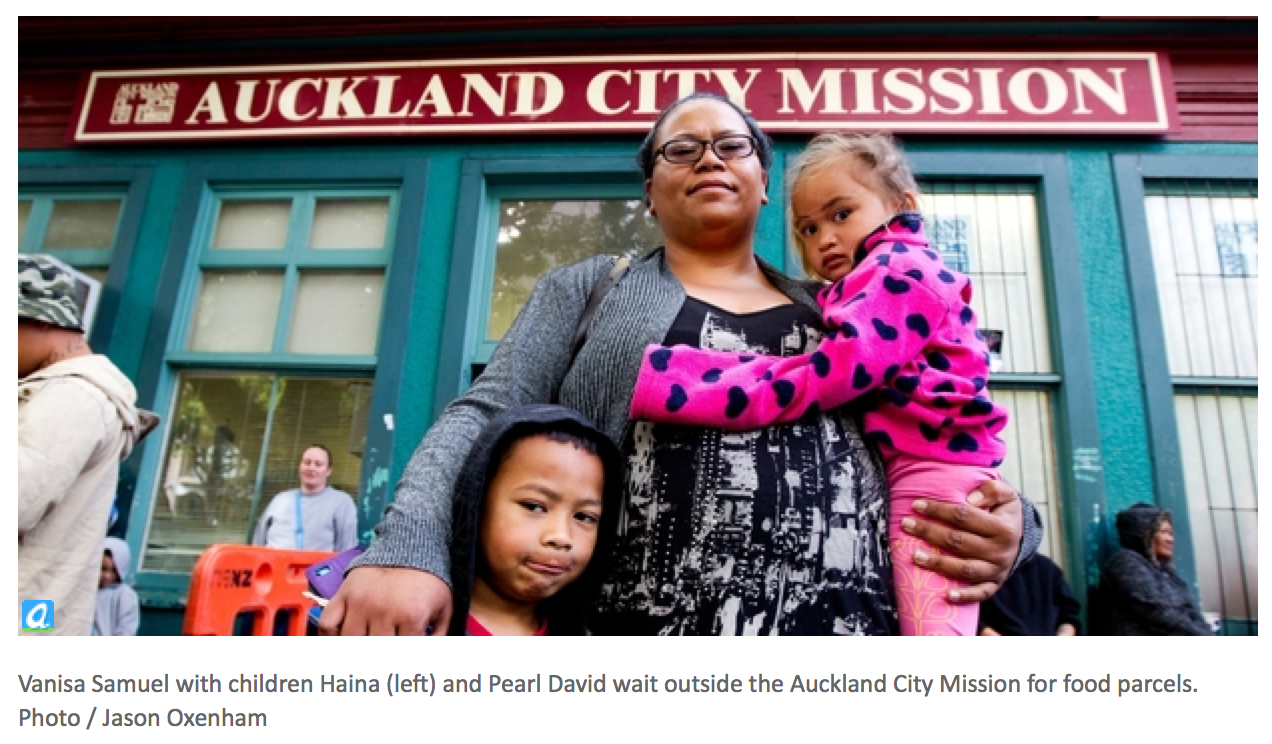
I was running, Hop card in my teeth, clutching my bag, pulling down my skirt and blinking away sweat. I was late. I was lost. And I'd forgotten to Google where Auckland City Mission actually was. But I needn't have worried. As I turned on to the corner of Hobson St, I froze. About 200 people were standing on the pavement.

It was the queue to get into the City Mission.

There was a TV3 guy in a sharp suit at the end of the line. He was trying to talk to people and was getting laughed at. I had to walk past him, and through the queue, to get to the door.

I've never felt younger, greener ... no, whiter, and more middle class than I did at that moment.

Inside, people were squashed into every corner. People sat hunched, elbows on knees, staring at me, or at the wall, or at the clock.

At my feet, a baby girl with dark curls wriggled around like a caterpillar.

I looked at her. Then I looked at my feet. I was wearing new trainers. I'd bought them yesterday. $180. A Christmas present to myself. White, high-heeled Nikes. They glistened like pig fat under the neon lights.

Eventually, when a bead of sweat had dribbled the full length of my spine, I got shown into Diane's office.

Diane Robertson, CEO of the Auckland City Mission, looked busy. She had one food parcel to distribute every eight minutes. She waved away my feeble small talk about the heat, pulled out the Family 100 Report on poverty in New Zealand, and talked for the next hour about the hideously intricate web of poverty.

I left. My stomach was tied in fierce knots at my own privilege, the injustice of the situation and the fact that some people had queued since 3am. There was still a queue at midday. They were waiting for a box of Weetbix, sausages and toilet paper.

Later that evening, I was in a funky Takapuna bistro for my girlfriend's birthday. It was one of those places where everything comes with an artistic olive. It was one of those places I felt comfortable walking into. One of those places I could wear the white trainers in.

It was also the place where I'd had one of my most heated dinner conversations ever. A guy had been telling me that we shouldn't have free breakfast in schools. Apparently parents who sent their kids to school without breakfast were irresponsible. If we gave them Weetbix, it'd only encourage this bad parenting.

The idea that poor people are bad parents is one of the ideas I heard a lot at school. It normally came alongside something like, "God, they just laze around, sponging off the government, living off benefits ... they don't even want a job."

There is prejudice and loathing, and then there are facts. The Family 100 Project, an online report compiled by Auckland Council, Auckland City Mission and Think Place, brings the truth of what's actually happening in the homes of the underclass.
You'll read, in story after story, about parents who don't eat so that their kids can. Parents who don't sleep in a bed so their kids can. Parents who will get up at 3am to queue, go through a five-hour ordeal of form filling, waiting, explaining, waiting, explaining again and waiting again ... just to get a box of Weetbix and sausages so their kids can eat at Christmas.

They don't sound like bad parents. They sound like heroes.

And when you read The Family 100 Project, you'll see there is a section on employment. You can read the interviews where people rhapsodise about working.

They want to work; it's a ticket out of poverty. It's a way to meet new people. It's a way to buy dinner every night of the week. And it's a self- confidence boost.

They don't sound like spongers. They sound willing, no, desperate to work.

And you can see the web of agencies that people living with poverty deal with in a fortnight. It's well over 20. Families must traipse from agency to agency, continually proving how they're 'legitimately poor'. I can't imagine what that's like. But it sounds like they work flat out to live.

We can do something about it. We can change the way we talk about poverty. We can donate to Auckland City Mission's 'Be Someone's Angel' campaign. Or we can think better of buying $180 trainers and buy two food boxes for a family instead.

I'm not sure I want these shoes now anyway. I thought they were a sparkly white. On closer inspection, I think they're a foul yellow.

Monday, October 8, 2012

Three Myths about Child Poverty

Jonathan Boston: Three myths about child poverty
8 October, 2012

After reading this article from the NZ Herald you may wish to make a submission to the Expert Advisory Group on Solutions to Child Poverty, established by the Children's Commissioner, has been assessing the best available international and domestic evidence on how to reduce child poverty and mitigate its effects.

The writer of this article, Jonathan Boston is the co-chair of this group, together with Dr Tracey McIntosh, of the University of Auckland. In late August they issued a discussion document outlining their initial proposals. They have also prepared 20 Working Papers on a multiplicity of policy issues. These are available on the website of the Children's Commissioner.

This group would greatly welcome your feedback on our ideas and proposals. In particular, they would like to hear your views on what you think can make the most difference.
They have stated that they will take outsider views into account as they prepare their final report.


Why some widely held beliefs on the causes and solutions are wrong and why it matters to put things right.


Photo / Getty Images

There are well-established, internationally recognised methods for measuring poverty.

Myth 1
There is little or no child poverty in New Zealand.
The evidence suggests otherwise. There are well-established, internationally recognised methods for measuring poverty. These can be used to track trends in poverty rates over time and between countries.
One commonly used poverty measure is the proportion of the population living in households with less than 60 per cent of the median disposable household income, after housing costs. This is a relative poverty measure. On this measure, 25 per cent of children were in such households in 2011. This represents about 270,000 children. Such figures compare unfavourably with those in Australia and many European countries. The situation was even worse a decade ago when close to 30 per cent of children lived in poverty. Yet in 1986 the figure was only 11 per cent.
Using a more demanding income threshold, around 170,000 children or 16 per cent are living in households receiving less than 50 per cent of the median disposable household income, after housing costs. This compares with about 10 per cent in Australia.
Poverty rates can also be assessed in constant value or real terms over extended periods of time. On this basis, the children in the poorest 15 per cent of New Zealand households are no better off today than 30 years ago. This is despite a substantial lift in average real per capita incomes since the early 1980s. This highlights that economic growth alone in not enough to overcome child poverty.
Another way of measuring poverty is to consider how many households cannot afford certain items which the majority of people believe are essential. This includes keeping one's home adequately warm, possessing a phone and a washing machine, and paying important bills on time. This measure of poverty focuses on hardship or deprivation rather than income.
As the accompanying table shows, child deprivation rates in New Zealand in 2008 were around 18 per cent. This compares with rates of 6-7 per cent in the best performing OECD countries.
Worse, many children experience persistent deprivation. The international evidence suggests that such children are at particular risk of bad outcomes later in life. This includes poor educational attainment, higher unemployment, poor health and a higher incidence of crime.

Myth 2
Children are poor and deprived mainly because their parents are bad, mad, foolish or indifferent. In other words, children are going to school hungry, have worn-out cloths and shoes, and live in cold houses because of poor, incompetent parenting. Every family has enough income, it is claimed. The problem is simply that some people don't know how to live within their means.
No doubt many parents struggle to cope with life, make unwise decisions or get trapped with high debt. Some suffer poor mental health or have drug, alcohol and gambling problems. These issues are real and need addressing.
But there is little hard evidence that poor people, as a group, are much worse than rich people in their capacity to manage their finances. The primary problem is that some parents simply don't have enough income to provide adequately for their children. And this includes many people who are in part-time and full-time work.
To those who say that children are deprived because their parents are incompetent or don't care, consider the following: whereas about 18 per cent of New Zealand children live in hardship, only 3 per cent of those aged 65 years and older suffer the same fate. Why are so few older people materially deprived?
The answer, very simply, is that governments have implemented policies to minimise deprivation among the elderly. By contrast, New Zealand society has chosen to tolerate significant child deprivation. We could choose otherwise.

Myth 3
We cannot reduce child poverty simply by increasing the incomes of poor families. Throwing more money at the problem, it is argued, doesn't work. For instance, it is claimed that the additional funding for low-income families provided via the Working for Families package, introduced seven years ago, has not reduced poverty.
Such claims are flawed. There is good international evidence that increasing the incomes of poor families, especially those with young children, improves educational, health and employment outcomes. Likewise, the Working for Families package has lifted tens of thousands of children out of poverty and significantly improved the financial circumstances of many other families. Broadly comparable policies in other countries have had similarly positive impacts.
But Working for Families is only part of the answer. More needs to be done, especially for the children of beneficiaries.
But what policy mix is best is by no means straightforward. There are various ways of increasing the incomes of poor families and not all of these are equally cost-effective or fiscally prudent. Moreover, while more money certainly helps, appropriate in-kind assistance is also important. This includes policies to address poor housing conditions, improve access to health care, educational and other services, and enhance employment opportunities.
How, then, can we improve the circumstances of the most deprived children in this country? How can we ensure that New Zealand is a great place to live for all our children? Over the past seven months, the Expert Advisory Group on Solutions to Child Poverty, established by the Children's Commissioner, has been assessing the best available international and domestic evidence on how to reduce child poverty and mitigate its effects.

I am the co-chair of this group, together with Dr Tracey McIntosh, of the University of Auckland. In late August we issued a discussion document outlining our initial proposals. We have also prepared 20 Working Papers on a multiplicity of policy issues. These are available on the website of the Children's Commissioner.

In sum, child poverty in New Zealand is unacceptably and unnecessarily high. It can be reduced, and it ought to be. Doing so would constitute a great investment in all our futures. But it will require public support, sensible policies, sustained effort and political will.
Jonathan Boston is professor of public policy at Victoria University and co-chair of the Expert Advisory Group on Solutions to Child Poverty.

Friday, July 6, 2012

Early Childhood Teachers Discuss Curriculum

I have spent a few days down south in Invercargill. It was certainly very cold as they have had some amazing frosts in the south, the hearts of the people are however very warm. Lots of very wonderful teachers, spending professional learning time together, reflecting on the ways in which they are deepening their practice around learning and teaching and Te Whariki.... 

The following is an article that was published in the Southland Times

Southern early childhood teachers went back to basics yesterday with a two-day conference focusing on delivering the curriculum in the 21st century. 

Convenor Pam Wilson, of Kindergartens South, said it was the second time the conference, held every second year, had been run in Invercargill. 

While some Early Childhood Education (ECE) teachers had attended the I love Teaching Conference for primary teachers, also held every two years, they had wanted to set up something specific for ECE, she said. 

The ILT and ILT Foundation supported the conference, she said. 

About 110 teachers from Dunedin and Invercargill attended the event, which finished today and was themed "Back to Basics - Te Whariki in the 21st Century". 

Te Whariki is the ECE curriculum document which was released in 1996, Mrs Wilson said.

The conference focused on rethinking the document and how it was put into practice in the 21st century.

Guest speaker Lyn Foote, director of Early Childhood Education at the University of Otago College of Education, yesterday spoke about the document, and getting the teachers to reflect on how they were using Te Whariki from a teaching and learning perspective. 

One of the biggest changes since the document was released in 1996 was the recognition of how much learning happened in the first five years, she said. 

Another change had been technology, something guest speaker Wendy Lee, director of the Educational Leadership Project, would discuss today. 

That had had a huge impact, particularly around documentation and the way teachers could share a child's progress with families, she said. They would also look at what children needed in order to express their ideas, be resilient, how to take responsibility, and how to use their imagination.

Wednesday, February 8, 2012

Report claims day care causes stress for children


Many of you will have seen this report in various forms around the country. Not only is it being published widely in newspapers but many of the local radio stations are making comment and getting comment from community members. It is important to discuss these issues with families and to challenge some of the questionable research findings. Advocacy for high quality ECE for all young children is critical. Keeping some of the real concerns visible e.g. the appalling legal ratio levels for babies in our country. No infant should be cared for by someone who is also caring for another 4 babies. A ratio of 1 teacher to 5 babies must be challenged! 


Conservative lobby group Family First is using a report from a controversial academic to claim day care is detrimental to children.

The group issued today the report that claims spending long periods of time in day care, and away from parents, is detrimental to a child's long-term development.
However, the study, by Dr Aric Sigman, hit the headlines last year in Britain, where it was questioned by experts. Dr Sigman is also behind a 2009 claim that Facebook and other social networking sites cause cancer. He was accused of "cherry-picking" evidence and ignoring that which did not support this theory. 

Writing in The Guardian last year, Dorothy Bishop, professor of developmental neuropsychology at Oxford, disputed his claims and questioned his credentials.
"Sigman ignores or selectively reports evidence for this more nuanced position," she wrote. "He justifies his one-sided approach to the evidence on the basis that "while open-mindedness has its place in academia, it is a luxury children can't afford".
Family First commissioned its report, Who Cares, to look at the increasing number of children and infants spending time in early childhood education while their parents are at work. 

Advocates say staying at home with their children is a luxury that many parents can no longer afford. 

Hayley Whitaker, early childhood spokeswoman for the NZEI union, said parental policies in New Zealand were "abhorrent" compared to other countries.
"We should be able to give people the choice to be at home with their children. They shouldn't have to feel that they're forced back into the workforce." 

However, there was a lot of evidence to show high-quality early childhood education benefited children, she said. 

"Everything in moderation, really." 

That quality depended on having qualified teachers and better student teacher ratios.
In his report, Dr Sigman said the level of a stress hormone, cortisol, was increased in 70 to 80 per cent of children in centre-based care. The hormone is produced in response to fear and uncertainty and too much of it was linked to a lowered immune system, he said. 

"Attending daycare for an extended time, whether small-scale and home-based, or large-scale and centre-based, that routinely triggers stress in young children could have potential long-term consequences for their mental and physical health as adults."
High-quality care did not override the effects, the report said. 

"The degree of warmth and affection, particularly between mother and child, can curb a child's stress reactions and generally make a child more resilient to stressful and difficult situations later on."

Dr Sigman recommended fulltime parenting should be a child's right, that the status of fulltime mothers should be enhanced and the current 14 weeks' paid parental leave be extended considerably.

Child Poverty Action Group spokeswoman Susan St John said the problems in accessing day care were inflexibility and the high cost.
"It's like a contract and a commitment, which then gets parents trapped on to a treadmill, and at the end of the day they might be quite surprised when they do the sums to work out that actually they're not much further ahead."

None of that was concerned with what was best for the child, she said.

Labour social development spokeswoman Jacinda Ardern said financial constraints often forced parents back into work.

"Families need to be able to make the decisions around the care of these children that work best for them, but right now it's not a matter of choice for many of them."
Labour's policies of Working For Families tax credits and 20 hours' free early childhood education were not designed to push people into work but to allow families to make the best choice for them, she said.

"ECE is not about day care, it's about education at an appropriate length of time for our children."
Labour campaigned on extending paid parental leave to 26 weeks.

Plunket spokeswoman Nikki Hooper said people were increasingly aware of the importance of the early months in a child's life. The organisation advocates six months' parental leave. 

'KIDS SHOW NO SIGN OF STRESS'

 
For 4-year-old Archie Bills, day care is so much fun he never wants to leave.
His mother, Sarah, said he was usually reluctant to leave Childspace in Wilton when she went to pick him up at the end of the day. 

"He always tells me he loves his teachers," she said. 

The Karori boy had not shown any signs of stress and was settled and happy.
"If we saw anything like that he would be out of child care." 

Mrs Bills and her husband, Hamish, made sure they spent time together as a family in the weekends and took turns picking him up from the early learning centre.
Stay-at-home dad Tim Richards said the benefits of children in day care outweighed the negatives. He and his wife, Megan, chose to send their sons Jack, 9, and Sam, 3, to St Mary's Early Childhood Education Centre at a young age to help develop socialisation.
Jack, who started preschool at the age of 1, quickly adapted, while Sam, who went at 2, took a few months to adjust to the child care environment, he said.
Both boys flourished, with their speech skills improving quickly along with their social skills. 

"I've never heard any parents who sent their kids there say that they're stressed."
Former Wellingtonian Haydn Jones and wife Zanta moved to Taranaki with their children Marley, 2, and Archer, 5 months, a year ago because they wanted to raise their children themselves. "I think it's a luxury to be able to raise our kids ourselves, which in itself is sad."

Friday, August 12, 2011

PM signals changes to preschool funding

By Elizabeth Binning
5:30 AM Friday Aug 12, 2011
Early Childhood Centres ar subsidised so they can provide children over 3 with 20 hours of free education. Photo/Thinkstock
Prime Minister John Key has dropped the strongest hint yet there could be changes to early childhood education funding - prompting fears thousands of parents will end up paying more.
During questioning this week Mr Key said he was not committed to keeping fee controls in place for the 20 hours scheme, something that would effectively allow centres to charge additional fees on free hours of care for more than 100,000 children.

Early Childhood Centres are subsidised so they can provide children over the age of 3 with 20 hours of free care. They are also subject to controls which prevent them from charging any additional fees for those 20 hours, although some teacher-led services can ask parents for "optional charges" if they have more than 80 per cent registered teachers.

Labour's education spokeswoman Sue Moroney has been questioning National about its plans for the popular scheme after speculation there are changes coming. The party has repeatedly said it is committed to 20 hours.

However, under questioning this week Mr Key gave the first indication that might not be the case.
He initially said the Government's position was that it would be maintaining the 20 free hours policy. But under further questioning he changed his stance saying he was committed to keeping the same subsidies for 20 hours' early childhood education but was not committed to keeping the fee controls for the scheme.

Ms Moroney said the implication was that the Government planned to allow centres to start charging extra fees for 20 hours which basically meant the end to the scheme.
"The only reason you would do that is if you are going to drop the subsidy."
When the Herald tried to seek clarification on what the Prime Minister meant, his office said ECE policy was still being formulated.

"The Government continues to stand by the commitments it made before the last election in relation to 20 Hours ECE, and we understand how popular it is with parents. ECE policy is still being formulated to take into the election campaign, and the public will get a good chance to assess it when it is released."

Educational sector union NZEI said it sounded like the Government was doing a "flipflop" on its election promise not to touch 20 hours.

Mr Key's comments follow a recommendation from the ECE Taskforce to remove fee controls for 20 hours and move to a funding model where working parents pay more for care.

PAYING FOR ECE
From Parliament's question time, Labour education spokeswoman Sue Moroney to the PM:
"Does he stand by the answer that he gave to the last question, that he is committing to keeping the same subsidies for 20 free hours' early childhood education and the same fee controls in place for 20 free hours' early childhood education?
John Key: No to the last bit.
What National's Anne Tolley (now Education Minister) promised in the last election campaign:
"While we will keep the scheme, it will be renamed '20 Hours ECE', instead of '20 Hours Free', which was patently misleading. We will retain all the existing subsidies and fee controls. But we will also make the scheme much more flexible for parents."

Wednesday, August 10, 2011

Fears 20 Hours policy under threat


New Zealand Herald
Tuesday 9th August 2011
By Elizabeth Binning
 Education Minister Anne Tolley is being urged to a take "an honest look" at Taskforce Report submissions before making any decisions that could affect the future of early childhood education (ECE). Public submissions closed yesterday on the recently released Taskforce Report which made a number of recommendations - including a major overhaul of the way early childhood education is funded.
The recommendation prompted fears from several groups, including Kohanga Reo and Playcentre, that funding cuts would lead to their demise.
The NZEI education sector union said yesterday the biggest concern was a proposal to water down the universal 20 Hours policy, which subsidises ECE for working parents.
"That would jeopardise the accessibility and quality of early childhood education to thousands of families," national executive member Hayley Whitaker.
"We know that the 20 Hours ECE policy has made it more affordable and has pushed up participation rates. Any move to dilute it would be a big step backwards and provoke an angry response from the community."
NZEI was also concerned about possible moves to introduce a market-driven model of pay for teachers saying that would erode professional salaries and employment conditions and ultimately reduce the quality of ECE for children and families.
Ms Whitaker said the Taskforce Report also recommended investment be a priority even in times of fiscal constraint and supported a return to 100 per cent qualified teachers, low adult-child ratios and small group sizes.
"But the Government has cut funding and actually moved to halt improvement on those issues, arguing early childhood education is an unaffordable cost. We hope it can... take the submissions to the Taskforce on board. To do anything else would make a mockery of the consultation process."
Ms Tolley said the Taskforce was independent and didn't necessarily reflect Government views. More than 3500 submissions had been received and the ministry would now prepare a report for her to consider. Any major changes would be taken into the election campaign.
"Funding almost trebled under the previous Government, yet participation increased by only about 1 per cent. [So] we comm-issioned an independent Taskforce to see how the system can work better for all children."
Meanwhile, more than 1200 Playcentre mums and toddlers gathered at Aotea Centre yesterday for what was planned as a protest over potential funding cuts. However, Ms Tolley stepped in last week to reassure funding would not be cut to any parent-led services so the protest became a celebration.
The group now urged the minister to consider pay parity with other early childhood education.
* * *
Taskforce recommendations:
* An overhaul of the funding system which includes a subsidy for 20 hours of care but strongly differentiated payments for special-needs children and those from Maori, Pasifika and low-income families.
* Working parents should pay more and fee controls should be removed - meaning costs could go up for parents, especially those on higher incomes.
* Public consultation has closed. Education Minister Anne Tolley will now consider submissions before making a decision about the future of early childhood education.


Monday, July 11, 2011

Hundreds march over early childhood cuts


The following was published in the Sunday News

Hundreds  marched up Auckland's Queen St yesterday to protest against government cuts to early childhood education.

The election year protest dubbed the "Big Push" by organisers was to have gone the full length of Queen Street from Queen Elizabeth Square in downtown to Aotea Square, but instead diverted to the Pioneer Women's Hall in Freyberg Square to avoid stormy weather. There, a few hundred-strong crowd of teachers and parents with pushchairs, buggies, and children in tow, saw a petition with more than 60,000 signatures presented.

Hayley Whitaker, an executive member of teacher's union NZEI Te Riu Roa, said funding had been cut to more than 2000 services as part of government plans to cut costs by abandoning the target of having early childhood centres staffed fully by qualified teachers. The petition calls for the government to commit to a plan to invest 1% of GDP on early childhood education as recommended by Unicef.

Primary teacher and vice-president of NZEI Frances Guy said the march yesterday helped raise the profile of early childhood education. "The government needs to reinstate funding that is so vital to children coming into primary school."

Clayton Park Primary school teacher Jackson Voot agreed on the importance of early childhood education. "I see kids who have had no early childhood education and it makes a huge difference. Those who don't get it are at a massive disadvantage. We know who the kids are who have not had the benefit of their right to early education."


The importance of having fully qualified early childhood educators was obvious, according to Voot. "You wouldn't put 80% qualified nurses in hospitals." Voot says "the government disincentivising early childhood education is disgusting".

Guy also said if both parents worked, it increased the importance of ensuring parents could leave their children with fully qualified professional educators. Parents at the march agreed changes were needed to early childhood education funding. Matt, who wished only to be known as a parent from Mt Albert, said funding cuts affected access to services for parents.

Critics hit out at 'child farms'


Article in the New Zealand Herald, published at 5:30 AM Sunday Jun 26, 2011

A centre in Petone run by Paradise Childcare Centres hopes to lift capacity to 100 children

Childcare centre operators are rushing to open so-called "megacentres" containing up to 150 children. A regulation coming into force this week allows childcare centres to triple in size. Even before the July 1 change, three companies have signalled to the Education Ministry they're keen to boost their centre sizes three-fold.


But critics are dubbing the big centres "child farms", as a survey finds 9 out of 10 parents and teachers oppose them.
The Education Ministry will allow centres to increase their rolls from 50 to 150, including 75 children aged under 2 years.
It says this will reduce red tape, by acknowledging big child centres are already disguising their existence by operating under multiple licences.


Education Minister Anne Tolley has said parents will not allow centres to get too big. The Education Ministry's acting early childhood education head, Karin Dalgleish, said she had received three "expressions of interest" from centres that intended to increase their size.She promised nothing would change for the children: their quality of care and education would remain unchanged.There were about 460 services that catered for more than 50 children under multiple licences, Dalgleish said.


Auckland developer Mac Manson said he had been approached by three childcare companies about renting his Newmarket building, which has been a gym and a church. He said the roof of one area could be removed to get past regulations that there must be an "outdoor area" for children.


And Paradise Childcare Centres general manager Brian Hogg said the chain had revamped an old Valentines Restaurant in Petone, reopening this week with a licence to care for 50 children. From next week, he hoped to increase capacity to 100. The children would be split into four groups, in separate areas. He would never go to the full legal capacity of 150 kids.
"It's just inappropriate to pack too many children into that space," he said. Parents would never leave their kids in a "warehouse environment", he said. 
But Dr Sarah-Eve Farquhar, from the ChildForum website, said an online survey of 450 people had revealed that 91 per cent opposed the change, voicing concerns about "crowd control" and children being "just a number". "There was a general disbelief at the claim on the Ministry of Education website that the quality of early childhood care and education would not be affected by an increase in the permissible number of children," Farquhar said. The regulation change would probably result in more commercial and large-scale services dominating the sector, she warned. Lower socio-economic families would be forced into the big centres, while those on higher incomes would seek out smaller "boutique operations".
"People who responded to the survey used terms like battery-farming kids, cattle-herding children, Kentucky Fried daycares, child farms and child warehouses," she said. "There's a lot of people in the field that fear what these potentially dangerous changes could mean for children." She urged the ministry to stop the change in guidelines until it had fully investigated the potential effect on children.


THE NUMBERS
* 50: Number of children allowed now at early childhood centres
* 150: Number of children allowed from July 1
* 460: Existing number of big childcare centres

Wednesday, June 1, 2011

20 hours free ECE faces the chop

Sue Moroney has this to say. (Media Release 1 June)
 The benefits of 20 hours free ECE will go and parents will face higher fees if the ECE Taskforce’s funding recommendations are implemented, says Labour’s Education spokesperson Sue Moroney.

Sue Moroney says the report recommends taking the fee controls off 20 hours ECE and argues that parents and employers should pay more of the funding for early childhood education.

“From the time that the Minister ordered the taskforce to stay within current funding but increase the number of children using the service, the taskforce was in a no-win situation,” Sue Moroney said.

“It’s a great shame, because the taskforce report clearly sets out why early childhood education should be a top priority for Government funding and has many excellent features to it.

“However, the National Government’s insistence that they see it as a cost, not an investment, means that the taskforce has ended up recommending some backward measures,” Sue Moroney said.

“This has also been reflected in the taskforce’s desire to fund 100 per cent qualified teachers, although it has ended up recommending only a subsidy towards this.

“This will unfortunately lead to further inequality as the report says ‘wealthier parents’ should be prepared to meet some of the cost of early childhood education, which includes some of the cost of a higher-quality workforce,” Sue Moroney said.

“This means that low and middle-income will get lower-quality education and this won’t fix the problem created by National’s funding cuts to ECE.”

Monday, April 25, 2011

School bullying reveals gap in natural justice


Written by Rosslyn Noonan and published in the Herald on 14th April 2011

Rosslyn Noonan is the Chief Commissioner, Human Rights Commission

Prime Minister John Key has called for a "national conversation" on how to reduce bullying in our schools. Political leadership is welcome on an issue that is complex and too often dismissed as unimportant and, at any rate, insoluble. A generation of students who live online as much as in real life have not hesitated to post scratchy recordings of vicious assaults. Each clip becomes a reminder that something has gone terribly wrong in the lives of both victim and bully.
Many parents of children who have been bullied feel powerless, often begged by their children not to raise it with the school because of their fear that it will just make things worse for them. But bullying, harassment and assaults cannot be ignored - they are human rights abuses.

"Any failure to treat bullying, abuse and violence seriously because it occurs between students, within schools, is a violation of a child's human rights." The statement comes from the Human Rights Commission's report School Violence, Bullying and Abuse: a human rights analysis. It was published in response to persistent complaints received from parents whose children were the victims of bullies. The analysis was completed in conjunction with the Office of the Children's Commissioner's inquiry into bullying: School Safety: An inquiry into the safety of students at school.
Everyone, but particularly children, as vulnerable members of society, has a right to personal security. They have the right to be safe and to feel safe. Bullying and harassment, assault and abuse, deny a child that right.
Children have a right to education.
If a child no longer feels safe at school, their education has been compromised as much as that of the bully who faces a stand-down or suspension. Some of the saddest complaints the Human Rights Commission has received come from the parents of children who have been the victims of serious bullying at school. Parents have said they felt let down by their schools and the Ministry of Education. In some cases the parents said the school never told them what had been happening, even when the bullying had been going on for some time and the school was aware of it. They felt excluded from the process, particularly any discussion about how to protect their child's safety when the bully returned to school.
The commission's analysis of school bullying revealed a fundamental gap in natural justice. Schools are required to inform the parents of a student who is suspended or stood down, but there is no equivalent guidance to say the victim's parents should be notified or even heard when a board of trustees is considering how to discipline a student who has been a bully. Without the right to be heard, the students who have faced harassment, violence and abuse are victimized again, this time by the process.
In March 2009 the commission made a series of recommendations, including asking the Ministry of Education to provide specific guidance to schools on how they should treat the victims of bullying. We offered to help with advice on these guidelines and had an initial meeting with two government agencies. The guidance must be founded on the principle that a young person's personal safety is the paramount concern and the starting point for the school's response to bullying. It is critical that boards of trustees be informed that the principles of natural justice apply to all those affected by their decisions - and not just to those subject to disciplinary action.
The commission specifically identified the timely opportunity to expressly include the rights of victims and their parents within the Ministry of Education's revised guidelines for principals and boards of trustees on stand-downs, suspensions, exclusions and expulsions.
None of the commission's suggested revisions were incorporated in that review process which was completed in February 2010.

Once again parents of children who have been bullied are claiming exclusion from the school decision-making. Even with the most incisive guidelines and policies, responding fairly to bullying comes down to how we treat each other. Along with genuine ownership of the problem there has to be a whole-of-school approach.
The commission is one of the supporters of the Human Rights in Education initiative, adopted successfully by many schools. We do so because the evidence says the surest foundation on which to build a safe and successful school community is clearly expressed and understood rights, responsibilities and respect for everyone.
The Human Rights in Education model has significantly reduced bullying, harassment and truancy in other communities. When students and teachers face less stress and disruption, everyone can get on with learning. It comes as no surprise that when this happens academic results improve.
Bullying is a complex issue with no easy solution and is not limited to schools. But the best place to start is to acknowledge we all share in the responsibility to ensure the safety and wellbeing of every child and young person wherever they are throughout our communities.


Wendy adds:

There are some very worthwhile resources available. Check out the Human Rights Commission for support in this area. Also I have a great deal of respect for the work of Barbara Coloroso.


She has contributed significantly in this area. Her books 'Kids are Worth it' (available through our website) and 'Parenting Through Crisis' are very useful books. She has also made a DVD titled 'The Bully, the Bullied and the Bystander: Breaking the Cycles of Violence, Creating Circles of Caring'. She outlines the deadliest combination "Bullies who get what they want from their target, bullied kids who are afraid to tell, bystanders who either watch, participate or look away, and adults who see the incidents as simply 'teasing' and a normal part of childhood.

I think her work gives us plenty to think about and reflect upon, our role as teachers and or bystanders and how we aid and abet the bully and how you can become peacemakers. This DVD is available through Amazon.com


Friday, June 25, 2010

Young thrive with skilled teachers - NZ Herald 25 June 2010

Margaret Carr and Linda Mitchell on why early childhood centres need qualified staff

We found it startling that questions are being raised about whether teachers in early childhood services should be qualified.
Especially when we know know so much about the significance for lifelong learning of the early years and about the complexity of the education and care task.
Prime Minister John Key is wrong to say "It is a matter of personal belief as to whether a high proportion of centre staff should be trained [teachers]".
This is not so. It is a matter of an informed and evidence-based decision.
Questions about qualified versus non-qualified teachers would never be raised about the adults who teach 5 and 6 (or older) year-olds in school.

The lessening of targets for employing qualified teachers and the removal of the top two rates of funding for early childhood services employing 80 to 100 per cent registered teachers will undermine the high quality of early childhood education that New Zealand should be aiming for.
The services that will be hardest hit are those very services that have managed to achieve a highly qualified workforce and that offer an inspiration and exemplar to others.
Research evidence is clear that positive outcomes for children and families participating in early childhood education depend on the quality of staff; child interactions; the learning resources available; programmes that engage children, and a supportive environment for children to work together.
The outcomes for a child include things such as motivation, persistence, reciprocity, resilience and imagination that will set children on a life-long learning journey.

They include cognitive outcomes such as numeracy, reading and language progress - outcomes the Government is particularly interested in.
A key characteristic of a early childhood service supporting these child outcomes is that the adults working with children hold early childhood teacher qualifications.

This was the finding of the 2003 US National Institute of Child Health and Development study on the impact of childcare quality on children's cognitive development.
Across 10 countries, a 2006 International Association for the Evaluation of Educational Achievement study of nearly 2000 children found that as levels of teacher education increased children's age-7 language performance improved.
The study found that teachers with more education use more words and more complex language in communicating with children.

Another US study of 800 4-year-olds, using data from the National Centre for Early Development and Learning, linked higher levels of teachers' education to gains on standardised measures of mathematics skills.

A myth has spread that early childhood education is over funded. Quite the reverse. New Zealand spends less on early childhood education than many countries.
A recent Unicef report (2008) suggested a benchmark and minimum level of 1 per cent of GDP should be spent by governments to ensure that childcare is managed in the best interests of children and societies.
New Zealand's level of funding is only 0.6 per cent of GDP. Its spending has increased three fold in the past five years, but it was woefully inadequate before.
And costs have increased because there are more services, more children participating, and more children attending longer hours than five years ago.
Money spent now on early childhood education saves money in the long run.

Together with Cathy Wylie at the NZ Council for Educational Research we recently completed a literature survey of outcomes of early childhood education, published by the Ministry of Education.
We found that investing in good quality early childhood education can bring actual cost benefits to government as well as to children and families.
One relevant study of quality provision with teaching staff qualified in special education and early childhood development followed the children to middle age.
It found that a dollar spent in early childhood saved $17 at age 40 in terms of the later cost of social services and criminal convictions, and the tax benefits from employment.

Key says that "There will be some [centre owners] that in the end say, "I want to be 100 per cent teacher-led", and I suspect that will be driven by the parents who send their children there and they may be prepared to pay a little bit more.
High income families whose children participate in early childhood centres will be able to afford the fees to maintain the high quality standard of 100 per cent qualified staff.
But low income families will not.
Economic inequality will now be associated from the early years with educational inequity.

The new education policy established by the May budget says that we cannot afford the financial cost of qualified teachers to provide care and education for all of New Zealand's youngest and most vulnerable of children.
We say that as a nation we cannot afford not to - the long-term social, economic and educational cost is too high.


Margaret Carr is Professor of Education and Dr Linda Mitchell is Senior Lecturer (Early Childhood Education) at the University of Waikato.

Tuesday, May 4, 2010

Three Professors of Education have their say!

Wendy writes:
I urge all teachers to share this press release with their families and to share their thoughts and concerns about the shifts in policy that are currently taking place in ECE in NZ. We are world leaders, and are considered by the rest of the world to be at the forefront of educational change. Our provision is regarded as one of the most outstanding in the world, we have had an enormous influence of early childhood provision internationally. We need to be talking about these issues with our local MP's. Take time to consider what you might do make visible what is currently happening to early childhood education in NZ.


Families should beware of the erosion of quality in Early Childhood Education, according to three Professors of Education

Families should be concerned about the steps that the government is taking to erode the quality of early childhood education in New Zealand, according to three Professors of Education, Helen May, Margaret Carr and Anne Smith.  The latest indication that cuts will be made to the funding for the Twenty Free Hours in the forthcoming budget, is just a further downward step in a long series of policy changes which are threatening the quality of New Zealand’s highly respected early childhood services.

Currently the discussions in the media are mostly about the cost to families. The cost of services is an important consideration for parents when they decide whether to enrol their children in early childhood education. Professors May, Carr & Smith hope the government will honour its election promise to keep the 20 Hours policy unchanged. They urge families to keep a critical eye on the quality of children’s experiences in centres, as well as on the cost. Government concerns about the 'trebling' in costs for early childhood education is in fact about the cost of policies intended to redress a long tail of: underfunding, low qualification levels, poor quality and high costs to parents. These successes are now under threat.

“Although this government has been keen to raise standards, it runs a great risk of undermining the quality of education in New Zealand by eroding some key aspects of the work in the early childhood sector. Children in quality early childhood do well at school, and this erosion is an example of inconsistent and disconnected policies” said Professor Margaret Carr at the University of Waikato. She added: “I fear that there may be more reduction of quality to come, seriously threatening the ability of the early childhood sector to work with families to provide the foundations for resourceful caring and imaginative citizens who love learning and know how to learn. Early years teachers work with children at an important time for brain development, and their work is highly skilled”.

Since coming to power, the government has removed or lowered expectations in a number of areas which influence quality.  These include:- 
  • the axing of professional development programmes for early childhood teachers to support implementing the early childhood curriculum;
  • cancelling the Centres of Innovation scheme - a project which showcased innovative practice to inspire other centres;
  • reducing to 80%, and extending the time frame, of the 100% goal of qualified  and registered early childhood teachers in all centres; 
  • reducing to 50% the requirement for qualified and registered teachers in provision for under-twos;  rescinding previously agreed improvements in the ratios of teachers to children;
  • reducing the training incentive grants

Centres which have 100% qualified staff, beyond requirements, are hugely concerned that the funding to pay teachers salaries linked to the number of qualified staff will be similarly cut back. Families will be concerned about this too.

“What happens to young children matters a lot, and if children don’t have access to top quality early childhood education during the early years, it is a missed opportunity to have a positive impact on their lifelong learning”, according to Emeritus Professor Anne Smith from the University of Otago. 

Professor Smith says that the evidence is overwhelming that in-depth teacher education is one of the most important elements of quality, which has long-term effects on young children’s learning, and she finds it inexplicable that the government is lowering expectations for early childhood training.  Under twos are particularly vulnerable to poor quality, so it’s just as important for people working with under two year-olds to be qualified as it is for older children.

Professor Helen May, Dean of the University of Otago College of Education reports that, “For some years New Zealand has been internationally regarded as a flagship in creating the necessary infrastructure of early childhood policy around issues of quality, qualifications, access and curriculum. There was still more to do, and the undermining of these policies is dispiriting, and even embarrassing, as there is continuing worldwide interest in our policy initiatives”.

Professors May, Carr and Smith are early childhood researchers who have had a major part in the development of early childhood policies in New Zealand for the last 30 years.

Professor Helen May
Dean University of Otago College of Education.

Emeritus Professor Anne Smith
University of Otago College of Education

Professor Margaret Carr
University of Waikato