Showing posts with label learning environments. Show all posts

Tuesday, March 26, 2013

Peter Hughes: Criticisms of maths skills don't add up


I have no doubt that many of you have been following the ‘maths’ stories inside the Herald over the last few weeks. Peter Hughes raises some interesting issues to contemplate. If you are interested in exploring some of these ideas an interesting read is ‘Catching Up or Leading the way: American Education in the Age of Globalisation’ by Professor Yong Zhao. This is a most interesting read. Yong Zhao was born and raised in China and is now a distinguished professor in America. He has a focus on the future and how we might best prepare children to be global citizens…..

While poor in some areas, NZ kids' results rank highly in international report evaluating real-world relevance.
Peter Hughes is a lecturer in maths education at the University of Auckland. He is co-author of 51 maths textbooks published in New Zealand, the US, Australia, and the UK.

Recent debates about learning the basic facts and the ability of our Year 9s in basic subtraction was kicked off in the media by New Zealand's results in Timss (Trends in Mathematics and Science Study) that showed we were doing poorly in maths.
In fact very different interpretations are possible if data from Pisa (Programme for International Student Assessment) 2009 is used.
The 2010/11 government report on Pirls (Progress in International Reading Literacy Study) and Timss show that in reading our Year 5s come 23rd out of 45 countries. In science Timss places our Year 9s at 31st out of 49. For mathematics the media reported that Timss places our Year 9 students 34th out of 53. In fact this is the Year 5 result. The correct figure for Year 9 is 16th out of 42. This misreporting has had an important negative effect on the debate about mathematics learning. It has opened the door to a flood of criticism in the press and talkback radio about learning the tables and doing standard pen and paper calculations. Yet the Timss report for Year 9 does not mention these things: "New Zealand's Year 9 tended to be very strong in data and chance (ie statistics and probability) and to a lesser extent number compared to their overall performance.
Practice, practice, practice is an invitation to extinguish creative and lateral thinking. Photo / Getty Images
 They were very weak in algebra and to a lesser extent geometry." It points to alarming weaknesses in algebra and geometry; we urgently need to work on these areas rather than number.
All these results are very depressing. Yet are they correct? Pisa suggests they may not be: according to Pisa our 15-year-olds are near the top of the world in all three subjects. Out of 65 countries, New Zealand ranks seventh in reading, 13th in maths, and seventh in science.
The countries that are ahead of us in Pisa when reading, maths, and science position are combined are China (Shanghai) first, Hong Kong second, Finland and Singapore third equal, Korea fifth, Japan sixth, and Canada seventh. And we come in at eighth in the world. This data will be used later. So how can Timss and Pisa produce such wildly contradictory results for New Zealand?
The student assessments are constructed from quite different perspectives. In essence, Timss starts with the curriculum and assesses how well the students are achieving, whereas Pisa starts from the opposite end and asks how well students can utilise their mathematics in the real world. While it would be unfair to say which of the two we should prefer - and there is a lot of research on this that highlights the major difficulties in making such judgments - we might well choose Pisa because of its links to real world problems.
George Lim in his opinion piece on March 20 explains why children in the highly ranked Asian countries do so well in school maths - quite simply they do lots of practice. Does this suggest a way forward for New Zealand in the teaching of maths? Evidence from the United States is useful in answering this question.
In both Timss and Pisa the US always rates poorly, and every time a new report comes along their politicians react hysterically. Voucher schemes, merit pay for teachers, and charter schools are among the tired old non-solutions they resurrect to solve the problem. Yet, as an American colleague has repeatedly pointed out, if the US education system is so bad, how do they dominate the world in such things as university rankings and number of Nobel Prizes awarded?
Comparing the US with the five Asian countries above on these two criteria we get some interesting results. Of the top 40 universities in the world 25 are in America, China has none, Japan one, Hong Kong one, Korea none, and Singapore one. Looking at Nobel Prize winners since 2000, the US has 64 (or 84 if the 21 born outside the US are counted), China has four, Japan 11, Hong Kong one, Korea one, and Singapore none. Readers can draw their own conclusions from this data, but I for one cannot infer that New Zealand should imitate the Asian countries' relentless emphasis on practice in learning maths. Until there is any evidence to the contrary the best assumption is that "practice, practice, practice", as George Lim puts it, is an invitation to extinguish creative and lateral thinking in maths, things which our best students currently are rather good at.
Thursday, November 24, 2011

Is Respect Part of Your Environment?


"Make the most of the small things in life because as time goes on, you realise these are the big things."
I read this in a shop recently and thought about these words this morning. My grand daughter Devon had stayed for the weekend. She is 8 and is lovely company. Devon likes to write on any paper she can find, this time on the small pad I keep in the car. I discovered a message on this pad today. It read "Hi,my name is Devon, whoever is reading this, I will tell you what cool is. Cool is an old Grandma! It made my day. I am not sure about the old part, in her eyes I must be ancient but I like the cool bit. Devon and I share lots of small things and this is what has built our relationship, through caring and sharing.
Children can give us well qualified reflections and descriptions, not just in our homes but in our centres. It just depends on how we do it and what relationships we have established with them. Sometimes we need to respect children's rights not to speak or to express themselves on unpleasant subjects or be challenged. Making time and space for children to express themselves and to be listened to is an example of how "in order to honour children's participation rights we must establish the conditions in which they can be honoured". (Mayall, 2000)

Thursday, November 10, 2011

OKATAINA RETREAT FOR LITERACY LEAD SETTINGS


We have just held our Literacy Leaderhip Retreat at the Lakes Lodge Okataina. Suffice to say that we were located right on the edge of the very beautiful Lake Okataina. We were in fact staying in what are the only dwellings on this lake, the Lakes Lodge. The lake and surrounding bush were gifted to the Crown by Ngati Tarawhai in 1921. Okataina is “place of laughter” this relates back to one of the important stories about this lake. We certainly experienced lots of laughter over the weekend. This lake is without outlets and is the only lake in the district that is surrounded completely by bush. The forest includes fine examples of  rimu, totara, rata and pohutukawa. Some of us explored the bush at night and were totally delighted to hear the sound of both kiwi and morepork. We also saw the glow worms throughout the bush. It was quite magical.


Throughout this blog are comments from teachers attending the Okataina Retreat.

“This weekend has great!! It has been cool to hear the stories from everyone else and to see how different everyone’s journey with their other centre has been. The honesty and support shown to each other made me feel more relaxed and comfortable to talk. “

“Having discussions both personal and professional is always interesting with other early childhood professionals. It’s a great opportunity to discuss and share ideas and experiences.. Today has been again insightful! Hearing and seeing others learning stories is fantastic. It is always a reflection of practice when you see other teachers practice. The different structure and content of the stories help to challenge and extend my own practice in assessment and learning for children in our kindergarten. Thank you ELp for providing the opportunity to share and learn from our colleagues.”

“I was very excited to be attending this weekend... I understand that it would be able sharing, but also talking and collaborative learning with others, which I really enjoy. Discussions not only about our ELP journeys, challenges and for us it is not over yet” .

“I was really looking forward to this weekend! For two reasons. First of all a relaxing weekend away, relaxation, the thought of ‘yummy food’, PEACE, and lots of good company. Secondly, again it was another opportunity for ‘team building’ as we were here as a complete team. I’ve noticed that these opportunities are enabling us to become a strong, resilient team, to get to know each other and to share a little more of ‘myself’.”

“This weekend has been a real treat for me, time away from home responsibilities, surrounded by great company, along with being taken care of by our awesome hosts. I have enjoyed our professional discussions, I am taking away many ideas to implement, to improve my practices.”
 

An opportunity to explore the possibilities of ephemeral art!


“I have never heard of Ephemeral Art. To actually create a piece of art using what you have around you to tell a story was a challenge but one that I enjoyed ...”

“ It was a cool experience to try and create ephemeral art to symbolise our journey as mentors and learners on this ELP journey”.


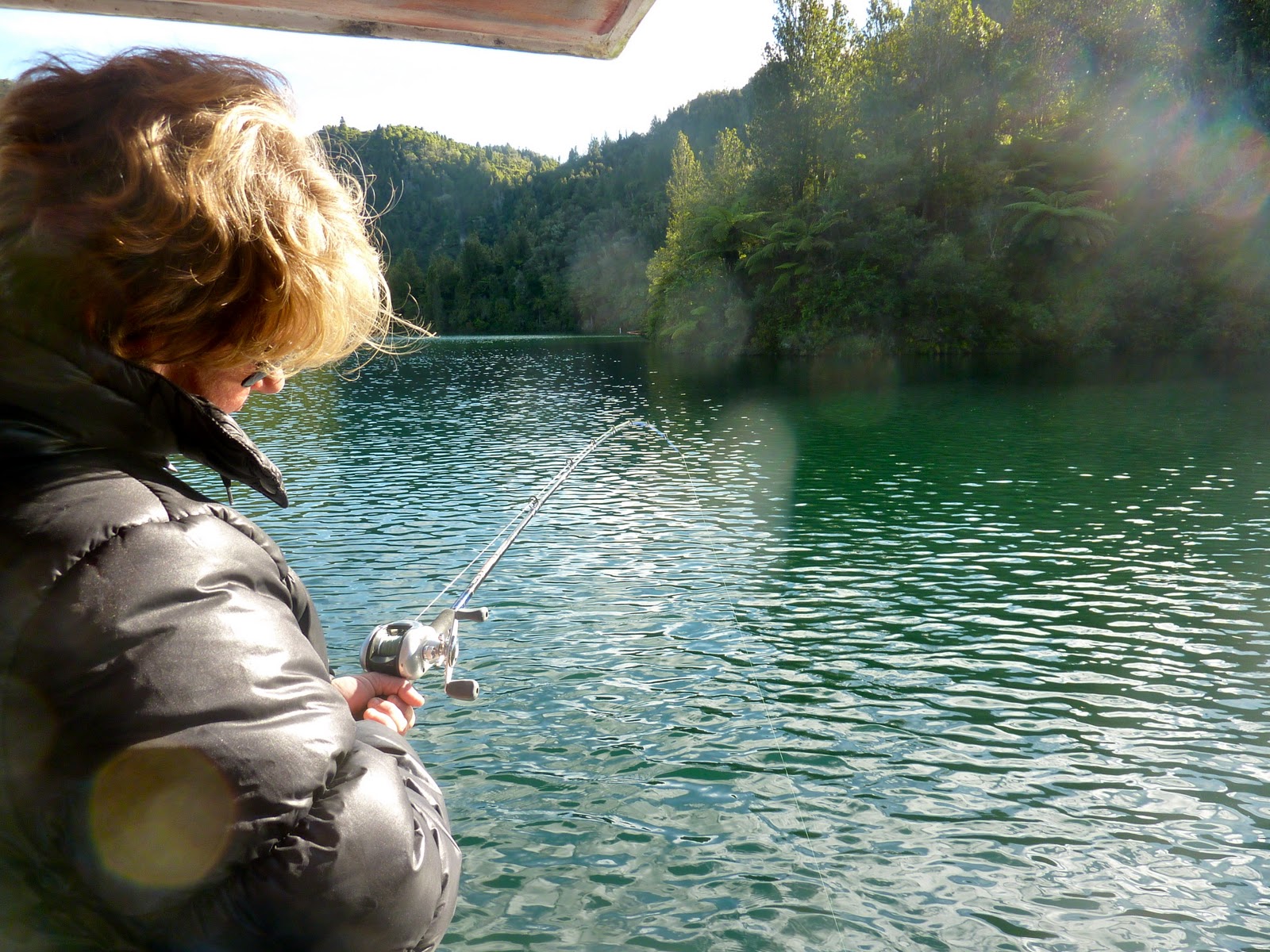
 “The fishing trip was a highlight for me. Fish are not on my list of favourite things and I am quite amazed with myself that I spent nearly all the time out the back with a rod in my hand, would have dropped it like a hot potato if something came on it!.”

“Yesterday was the first time I had been fishing, so now I have gained some skill and knowledge”

“It was so relaxing to be fishing on this lovely boat, a real opportunity to quietly reflect and to be in the moment”.


 There were challenges with the fishing as well! We did manage a fairly major tangle!!!

We travelled across the lake and spent time in different parts of the lake. The peace the tranquility....

“The lake was so quiet, apart from two kayakers we saw no one else on the lake over the four hours we were exploring and fishing on the lake, wow, such peace. It was so beautiful”.


Some took opportunities to get up on top and enjoy the view!


Inside the boat more opportunities to share and chat

 “It was cool to be able to just sit around on the boat, in such a beautiful environment, just enjoying the peace and tranquility and the company of others.”

Saturday night dinner was a celebration! Fish philosophy in action. A time to play and be a little creative!
“The props at dinner added fun to the night and shows that as adults we find dressups fun too!”
“ Fabulous food and a wonderful celebration, such a treat!”


“ All in all this retreat has been an amazing weekend filled with laughter, talking and friendship. As a practitioner I have been provided with an opportunity to engage in numerous professional discussions, be creative and reflect on ‘wise practice’. Thank you”

“Being near water this weekend has been healing. I have enjoyed being part of a group of like minded people who have this common bond and purpose. Listening to the korero lead me to think about my journey - kia ora. Having time on the lake gave me time to ‘be’. I don’t get much opportunity for that, so it has been a weekend of reflection, rest and connecting. Thank you for making it possible.”

“I have discussed this weekend, the things that make me who I am. I have enjoyed the fellowship of my colleagues and felt accepted as part of the group. I have felt supported on my teaching journey in a way that I some times miss in my professional life. I have felt my ideas and feelings have been valued. I have learnt from listening and talking with others.
I will take away with me further knowledge and an increased confidence in my ability to find further learning from a variety of areas around me, people, reading etc. I aim to read about learnt optimism.”

“It has been a very relaxing weekend, with a variety of activities. I thoroughly enjoyed my morning walks with my friends. Can’t remember when I have laughed so much and for so long. The venue was superb, fantastic choice, Okataina has certainly lived up to it’s name (place of laughter).”

“Beautiful setting, beautiful people - ka pai .... Whakawhanaungatanga is very present at Okataina.”

“Food, company and new learning has been wonderful and as I sit here looking at the photo’s of this weekend moving across the screen in front of me, I feel lucky to have had this opportunity to have fun, share ideas and just come together. To Wendy and Alison, it was a privilege to listen to your wise words and  to be treated to such a special time..thank you.”


Tuesday, November 8, 2011

Eden Creative Recycling

Eden Creative Recycling

Last week I finally had time to visit Eden Creative Recycling, a charitable trust set up to collect pre-consumer waste from businesses so that members can reuse these.
I spoke to Yvonne who showed me around and we talked about sustainability through art, in particular thinking about composite art through recycled materials which are able to be used again and again.

"Our intention is to provide alternative resources for children that may encourage creativity, and a new way of reusing ‘waste‘ which may cultivate a more sustainable approach to learning. Children and adults are able to explore and engage with these resources, reinventing uses for these items and giving them new identities." Eden Creative Recycling Website

 
As part of your membership you will have access to the centre during opening hours, as well as workshops where you can explore the materials yourself. There is more information on their website http://www.edencreativerecycling.org.nz/ or you can access their Facebook site through this link http://tinyurl.com/6sjny2h
Yvonne said they are keen to source more reusable materials so if you know of a good source and are willing to share, drop Eden Creative Recycling an email - the address is on the website. There is also details of membership costs as well as opening hours.


Eden Creative Recycling

Eden Creative Recycling

Eden Creative Recycling


Eden Creative Recycling

Eden Creative Recycling

Eden Creative Recycling

Eden Creative Recycling

Eden Creative Recycling

Eden Creative Recycling


Eden Creative Recycling

Tuesday, November 1, 2011

The Pleasure of Play and Puppies


During the weekend I visited my son and his family. They were out but their 3 puppies were romping on the back lawn. I sat on the deck and watched them with delight as they played together and thought about the learning that was happening for them. Sometimes all three would wrestle together, then one would detach and hide behind the tree and watch and when he thought it was the right time, would bound out with obvious glee and join in. Watching, smelling the ground, times for action and time for quiet and thinking and able to explore the environment is valuable learning for these puppies. I come from a farming background and have witnessed this learning with many young animals, through play and fun. My own childhood was filled with fun and play with my siblings and I have grown up with memories of making huts in the native bush, playing ‘birds’in the long grass, dressing puppies in baby clothes to take them for rides in the pram and feelings of peace and serenity in a natural play setting for children and having parents who realised the value of this play for us.


I reflected on how this puppy play is how our young children learn but sometimes we lose sight of this in our busy world where so much emphasis is on academic achievement. Are we losing sight of these precious years where the importance of learning is through play, to wonder, to be curious and to find out about our friends and develop social competence through being able to make mistakes and try again.

Through play and exploration, these young children will develop dispositions to help them deal with an uncertain world as they grow older.

Margaret Carr and Guy Claxton remind us that dispositions to learn are verbs i.e. contributing,exploring, collaborating, persisting,questioning etc, we do not acquire dispositions. We become more or less disposed to learning in certain ways - or not!


Are teachers through lack of knowledge, but believing they are doing the right thing by insisting on group times or kindy sessions (interestingly, I have never seen a kindy session in kindergartens!) limiting the learning of these children by denying them play over a long period. Surely short play times are just filling in time, good for teachers maybe but of little value for children.

As we nurture the disposition of ‘loving to learn’ through play, we need to feel confident that we are doing the right thing for these young children and strive for an environment where provocations widen and deepen learning and teachers are engaged in their own ongoing learning so that skills, knowledge and dispositions are strengthened for everyone in the learning community and literacy and mathematical skills sit alongside effort, teamwork, friendship, courage and curiosity to make assessment so much more meaningful and brings TeWhāriki to life in ways that show our children as capable and confident.

This learning environment needs effort to make it an environment where ‘deep listening’ is part of the pedagogy. Langsted (1994) argues that structures and procedures are important but;.... more important is the cultural climate which shapes the ideas that the adults in a particular society hold about children. The wish to listen to and involve children originates in this cultural climate. This wish will then lead to structures and procedures that can guarantee the involvement of the children. (pp41-2)

Children’s play reflects their social and cultural context and we need to understand the importance of the social and cultural context in which children live and avoid making generalisations that assume that some forms of play are typical or essential. I thought about this as I watched some boys playing ‘pig hunting’ at their centre after an excursion where they went pig hunting through native bush, carrying their toy guns and knives. This is what their whanau do each weekend and their play reflected an in depth knowledge of catching pigs with dogs, the singeing and preparing the meat for hangi, meaningful learning for these young children within the contexts of their family life. This play is upholding the mana of these boys, they are supported, respected and given choices so that their potential can be reached, an example of whakamana or empowerment.


Play has many different theories and there is so much that can be written about it.

Maybe we should leave the definition of play from those involved - the players; see ‘Play is having fun’ and ‘it has to be work if you tell us to do something’.

Monday, October 3, 2011

Go, the Rugby, Go


We got up close and personal with the Namibian and Fijian players at their game at Rotorua International Stadium a few weeks ago. I was struck with the players ability to get up and face another tackle again and again. And... to run fast into another tackle just after having the magic water applied.

Hawaiki, 3 1/2, and Pipiana, nearly 2, play rugby. They have balls and some black tshirts and ALL BLACKS socks!! Hawaiki said, "I am going to be an ALL BLACK." I replied, "Oh yes and I will come and watch every game you play - it is such a lot of hard work to be an All Black and you have to do lots of practice." He nodded. I said, "Pipiana could be an All Black too". Hawaiki looked at me, the disdain and disbelief apparent on his face. "No," he said "she can be a ballerina." I gave the lecture on the women's rugby team, the Black Ferns, who have won four world cups. I know, I know, I have some work to do there! and on me too - I am not sure the lecture was the best teaching tool with a 3 1/2 year old.

Hawaiki and Pipiana play rugby with Nana. I chase them and tackle them, push and lean on them, and try very hard! to get the ball off them. They wrestle and roll, pick themselves up and run again. Pipiana sometimes falls to the ground and feigns a tackle just before I make contact and lies there "injured". I know, I know, I have some work to do there too! We play this until Nana is tired!

Last week I visited an early childhood centre and went on the 'Farm Trip' with them. We had a lovely time and lots of learning happened there for us all. They enjoyed the experience of the farm and the animals. Lambs and chickens to hold and feed are opportunities for lots of dipositional learning. We shared a birthday party with a three year old and her family. After lunch some balls appeared and it was all on. Well an expansive learning environment just appeared. The invitations and provocations were all there. Space, grass and balls.

We played rugby. Teachers and children -18months to five - were on the field. The teachers chased and tackled, and ran and refereed. I, a strange adult, tackled one little girl- yes I know a teaching intention risk that I thought I may have got very wrong as she lay on the ground and was unhappy. Another teacher came over and we supported her recovery - no magic water - just magic kindness and care - teaching about how to recover and be resilient.

And so... I have been thinking about the learning that happens with 'rugby' play. Or any play like it really. I take liberty with Margaret Carr's statement now and say 'It is not about the rugby, the running or the popular culture, it is about that activity of the child's own choice being the vehicle for the learning, and for the dispositional learning we value most'.

Learning I value such as;
  • trying something new or practicing something familiar - being involved and courageousness - some children watched for quite sometime before they were ready to join in - but join in they did.
  • being brave and persistent, picking yourself up even after a hard emotional or physical knock, asking for help or having another go and keeping going.
  • helping a friend or care for the toddler who has joined the four year olds in the ruck, or giving the ball to the chaser who now wants to be the runner.
  • being delighted and happy at the chase.
  • being satisfied and reflective about the outcomes.
  • being resilient. Playing the game another day or choosing another kind of game and learning something new.
  • knowing that these are learning strategies that will work with other new learning.
This learning will take children far beyond knowledge and skills, it will take children in to a 'possible self' and a future we know nothing of.

A future that involves winning or losing or getting badly injured and maintaining your strength of character.
Go the All Blacks Go! and Go our passion and pleasure in joining in with children and following their learning leads.

Kathryn